343 posters, 5 videos, 2 audios, 18 topics, 33 sessions, 263 authors, 202 institutions
ePostersLive by SciGen Technologies S.A. All rights reserved.
24th Annual Pain Medicine Meeting 2025
November 13-15, 2025| JW Marriott Austin, Austin, Texas

2195224
Multilevel Vertebral Hemangiomas Complicating Basivertebral Nerve Ablation Technique Following Kyphoplasty
Poster Presenter
Authors
Affiliations
Part of Topic
Medically Challenging Cases
Vertebral hemangiomas are commonly incidental findings and rarely symptomatic; may pose technical challenges when associated with vertebral endplate changes.
Basivertebral nerve ablation (BVNA) has emerged as an effective treatment for chronic vertebrogenic back pain, particularly in patients with Modic type I and II changes.
Hemangiomatous bone presents unique procedural difficulties for ablation due to:
• Softened tissue composition
• Unpredictable electrical impedance⁴,⁵
BVNA was performed at L4, 5, and S1.
Case Summary:
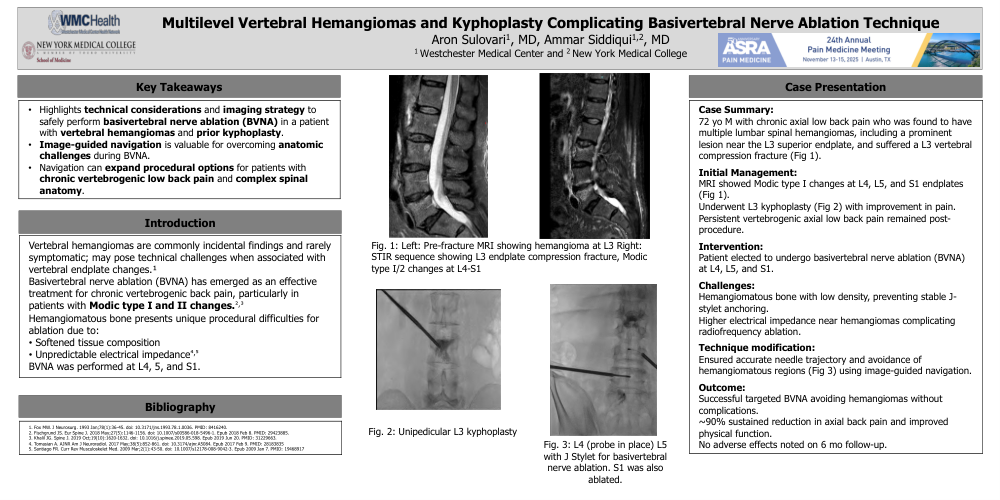
72 yo M with chronic axial low back pain who was found to have multiple lumbar spinal hemangiomas, including a prominent lesion near the L3 superior endplate, and suffered a L3 vertebral compression fracture (Fig 1).
Initial Management:
MRI showed Modic type I changes at L4, L5, and S1 endplates (Fig 1).
Underwent L3 kyphoplasty (Fig 2) with improvement in pain.
Persistent vertebrogenic axial low back pain remained post-procedure.
Intervention:
Patient elected to undergo basivertebral nerve ablation (BVNA) at L4, L5, and S1.
Challenges:
Hemangiomatous bone with low density, preventing stable J-stylet anchoring.
Higher electrical impedance near hemangiomas complicating radiofrequency ablation.
Technique modification:
Ensured accurate needle trajectory and avoidance of hemangiomatous regions (Fig 3) using image-guided navigation.
Outcome:
Successful targeted BVNA avoiding hemangiomas without complications.
~90% sustained reduction in axial back pain and improved physical function.
No adverse effects noted on 6 mo follow-up.
Citations:
1. Fox MW. J Neurosurg. 1993 Jan;78(1):36-45. doi: 10.3171/jns.1993.78.1.0036. PMID: 8416240.
2. Fischgrund JS. Eur Spine J. 2018 May;27(5):1146-1156. doi: 10.1007/s00586-018-5496-1. Epub 2018 Feb 8. PMID: 29423885.
3. Khalil JG. Spine J. 2019 Oct;19(10):1620-1632. doi: 10.1016/j.spinee.2019.05.598. Epub 2019 Jun 20. PMID: 31229663.
4. Tomasian A. AJNR Am J Neuroradiol. 2017 May;38(5):852-861. doi: 10.3174/ajnr.A5084. Epub 2017 Feb 9. PMID: 28183835
5. Santiago FR. Curr Rev Musculoskelet Med. 2009 Mar;2(1):43-50. doi: 10.1007/s12178-008-9042-3. Epub 2009 Jan 7. PMID: 19468917