343 posters, 5 videos, 2 audios, 18 topics, 33 sessions, 263 authors, 202 institutions
ePostersLive by SciGen Technologies S.A. All rights reserved.
24th Annual Pain Medicine Meeting 2025
November 13-15, 2025| JW Marriott Austin, Austin, Texas

2195032
Considerations of Vertebrogenic Lower Back Pain After Basil-Vertebral Nerve Ablation (BVNA) Complicated in a Postmenopausal Woman
Poster Presenter
Authors
Affiliations
Part of Topic
Medically Challenging Cases
Background & Rationale
Chronic Low Back Pain (CLBP) & Osteoporosis
CLBP is a leading cause of disability in older adults
Vertebral endplate pathologies, including Modic changes, are linked to persistent back pain
BVNA is increasingly used for CLBP but remains relatively contraindicated in osteoporosis (T-score < –2.5)
Knowledge Gap
Few studies document Modic changes post-BVNA in osteoporotic patients
High-risk populations (postmenopausal women, prior spinal surgery) require careful pre-procedural screening
Considerations of Vertebrogenic Lower Back Pain After Basivertebral Nerve Ablation (BVNA) Complicated in a Postmenopausal Woman: Case Report
Case Summary
Patient Overview
63-year-old female with history of OSA, hypertension, GERD, IBS, osteoporosis, prior L3–S1 microdiscectomy
Persistent postsurgical low back pain treated with L3–L5 medial branch RFA and L5–S1 BVNA
Clinical Presentation
Pain: stabbing, burning, tingling; worsened with flexion/extension; radiates to toes
Medications: oxycontin, pregabalin
Imaging Findings
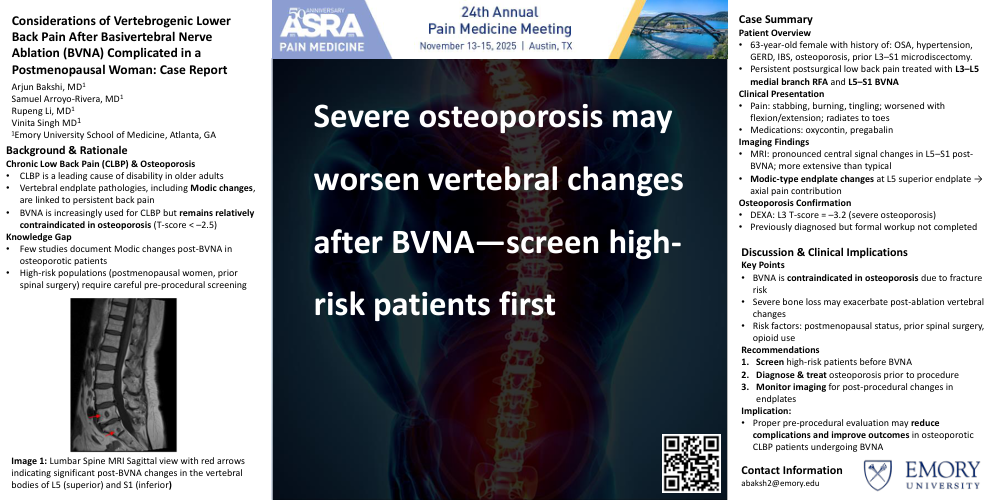
MRI: pronounced central signal changes in L5–S1 post-BVNA; more extensive than typical
Modic-type endplate changes at L5 superior endplate contributing to axial pain
Osteoporosis Confirmation
DEXA: L3 T-score = –3.2 (severe osteoporosis)
Previously diagnosed but formal workup not completed
Discussion & Clinical Implications
Key Points
BVNA is contraindicated in osteoporosis due to fracture risk
Severe bone loss may exacerbate post-ablation vertebral changes
Risk factors include postmenopausal status, prior spinal surgery, and opioid use
Recommendations
Screen high-risk patients before BVNA
Diagnose and treat osteoporosis prior to the procedure
Monitor imaging for post-procedural changes in endplates
Implication
Proper pre-procedural evaluation may reduce complications and improve outcomes in osteoporotic CLBP patients undergoing BVNA
Image 1: Lumbar Spine MRI Sagittal view with red arrows indicating significant post-BVNA changes in the vertebral bodies of L5 (superior) and S1 (inferior)
Severe osteoporosis may worsen vertebral changes after BVNA—screen high-risk patients first