343 posters, 5 videos, 2 audios, 18 topics, 33 sessions, 263 authors, 202 institutions
ePostersLive by SciGen Technologies S.A. All rights reserved.
24th Annual Pain Medicine Meeting 2025
November 13-15, 2025| JW Marriott Austin, Austin, Texas

2194727
Salvage of failed Posterior Sacroiliac Joint Fusion with Single Compressive Lateral Transfixing Implant.
Poster Presenter
Authors
Affiliations
Part of Topic
Medically Challenging Cases
Video
Category: Medically Challenging Case Title: Salvage of failed Posterior Sacroiliac Joint Fusion with a Lateral Transfixing Implant: A Case Report
Project Chair: Mazhar Rasul, MD Principal Investigator/Submitting Author: Mazhar Rasul, MD Co-Author(s): N/A
Introduction: Sacroiliac joint (SIJ) dysfunction is increasingly recognized as a common but frequently underdiagnosed source of chronic axial low back pain. Up to 30% of patients with chronic low back symptoms may have pain attributable to SIJ pathology. Minimally invasive SIJ fusion has emerged as an effective and durable treatment for patients who fail conservative therapy. Posterior allograft-based fusion has been favored for its soft tissue preservation and percutaneous access, though questions remain regarding its biomechanical durability and long-term fusion rates, particularly in active or high-risk patients. In contrast, lateral transiliac fixation using titanium implants provides cortical engagement, compressive fixation, and immediate mechanical stability. While the lateral approach is widely accepted as a primary treatment strategy, its application in salvage scenarios following posterior fusion failure is less well described. There is currently limited clinical guidance on approach selection when prior posterior fusion results in suboptimal integration. This case report presents successful revision of a failed posterior allograft SIJ fusion using a lateral compressive implant in a veteran patient.
Methods: The patient provided informed consent for case presentation. All protected health information was de-identified.
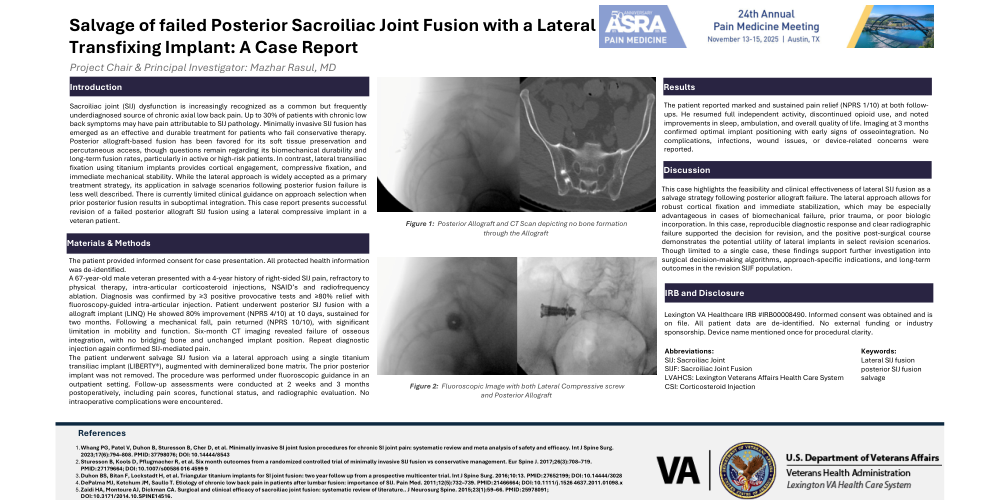
A 67-year-old male veteran presented with a 4-year history of right-sided SIJ pain, refractory to physical therapy, intra-articular corticosteroid injections, NSAID’s and radiofrequency ablation. Diagnosis was confirmed by ≥3 positive provocative tests and ≥80% relief with fluoroscopy-guided intra-articular injection. Patient underwent posterior SIJ fusion with a allograft implant. He showed 80% improvement (NPRS 4/10) at 10 days, sustained for two months. Following a mechanical fall, pain returned (NPRS 10/10), with significant limitation in mobility and function. Six-month CT imaging revealed failure of osseous integration, with no bridging bone and unchanged implant position. Repeat diagnostic injection again confirmed SIJ-mediated pain.
The patient underwent salvage SIJ fusion via a lateral approach using a single titanium transiliac implant (LIBERTY®), augmented with demineralized bone matrix. The prior posterior implant was not removed. The procedure was performed under fluoroscopic guidance in an outpatient setting. Follow-up assessments were conducted at 2 weeks and 3 months postoperatively, including pain scores, functional status, and radiographic evaluation. No intraoperative complications were encountered.
Results: The patient reported marked and sustained pain relief (NPRS 1/10) at both follow-ups. He resumed full independent activity, discontinued opioid use, and noted improvements in sleep,
ambulation, and overall quality of life. Imaging at 3 months confirmed optimal implant positioning with early signs of osseointegration. No complications, infections, wound issues, or device-related concerns were reported.
Discussion: This case highlights the feasibility and clinical effectiveness of lateral SIJ fusion as a salvage strategy following posterior allograft failure. The lateral approach allows for robust cortical fixation and immediate stabilization, which may be especially advantageous in cases of biomechanical failure, prior trauma, or poor biologic incorporation. In this case, reproducible diagnostic response and clear radiographic failure supported the decision for revision, and the positive post-surgical course demonstrates the potential utility of lateral implants in select revision scenarios. Though limited to a single case, these findings support further investigation into surgical decision-making algorithms, approach-specific indications, and long-term outcomes in the revision SIJF population.