Loading...

343 posters, 5 videos, 2 audios, 18 topics, 33 sessions, 263 authors, 202 institutions

ePostersLive by SciGen Technologies S.A. All rights reserved.

24th Annual Pain Medicine Meeting 2025

November 13-15, 2025| JW Marriott Austin, Austin, Texas

24th Annual Pain Medicine Meeting 2025 banner

2192397

Restarting Rivaroxaban with an Erector Spinae Plane Catheter after Thoracic Surgery
Part of Topic

Medically Challenging Cases

Restarting Rivaroxaban with an Erector Spinae Plane Catheter after Thoracic Surgery

Benjamin D. Mirman, MD1, Amir Taree, MD1, Andrew Kaufman, MD2,  Daniel Kanzer, MD1


1 Department of Anesthesiology, Icahn School of Medicine at Mount Sinai, New York, NY

2 Department of Thoracic Surgery, Icahn School of Medicine at Mount Sinai, New York, NY


Introduction


•Thoracic epidural analgesia (TEA) is the gold standard for acute post-thoracotomy pain; catheter placement/removal contraindicated in anticoagulated (AC) patients due to risk of epidural hematoma [1]
•The erector spinae plane (ESP) catheter is an alternative technique with less stringent AC guidelines [2]


Here, we present a 78-year-old male with a complex history requiring perioperative AC who underwent successful ESP catheter placement for thoracic analgesia.


Methods


•Devoid of patient identifiable information, exempt from IRB review as per Mount Sinai Hospital policy
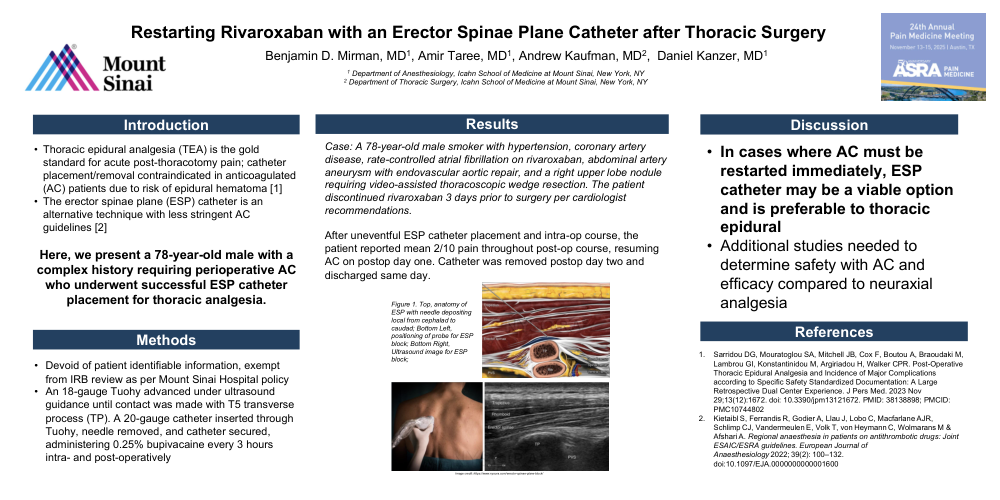
•An 18-gauge Tuohy advanced under ultrasound guidance until contact was made with T5 transverse process (TP). A 20-gauge catheter inserted through Tuohy, needle removed, and catheter secured, administering 0.25% bupivacaine every 3 hours intra- and post-operatively


Results


Case: A 78-year-old male smoker with hypertension, coronary artery disease, rate-controlled atrial fibrillation on rivaroxaban, abdominal artery aneurysm with endovascular aortic repair, and a right upper lobe nodule requiring video-assisted thoracoscopic wedge resection. The patient discontinued rivaroxaban 3 days prior to surgery per cardiologist recommendations.  


After uneventful ESP catheter placement and intra-op course, the patient reported mean 2/10 pain throughout post-op course, resuming AC on postop day one. Catheter was removed postop day two and discharged same day. 


Discussion


•In cases where AC must be restarted immediately, ESP catheter may be a viable option and is preferable to thoracic epidural
•Additional studies needed to determine safety with AC and efficacy compared to neuraxial analgesia 


References


1.Sarridou DG, Mouratoglou SA, Mitchell JB, Cox F, Boutou A, Braoudaki M, Lambrou GI, Konstantinidou M, Argiriadou H, Walker CPR. Post-Operative Thoracic Epidural Analgesia and Incidence of Major Complications according to Specific Safety Standardized Documentation: A Large Retrospective Dual Center Experience. J Pers Med. 2023 Nov 29;13(12):1672. doi: 10.3390/jpm13121672. PMID: 38138898; PMCID: PMC10744802
2.Kietaibl S, Ferrandis R, Godier A, Llau J, Lobo C, Macfarlane AJR, Schlimp CJ, Vandermeulen E, Volk T, von Heymann C, Wolmarans M & Afshari A. Regional anaesthesia in patients on antithrombotic drugs: Joint ESAIC/ESRA guidelines. European Journal of Anaesthesiology 2022; 39(2): 100–132. doi:10.1097/EJA.0000000000001600 
 
24th Annual Pain Medicine Meeting 2025 banner
Copyright © 2015-2026, ePostersLive® SciGen is a registered trademark of SciGen Technologies S.A. Patent pending.

This website and third-party tools we use rely on cookies for the best user experience. By selecting "I agree", you agree to cookie usage as described in our Privacy Policy.