343 posters, 5 videos, 2 audios, 18 topics, 33 sessions, 263 authors, 202 institutions
ePostersLive by SciGen Technologies S.A. All rights reserved.
24th Annual Pain Medicine Meeting 2025
November 13-15, 2025| JW Marriott Austin, Austin, Texas

2190484
A " Hail Mary" Use of Sciatic Peripheral Nerve Stimulation for Intractable Ischemic Limp Pain in Non-Reconstructable PAD
Poster Presenter
Authors
Affiliations
Part of Topic
Medically Challenging Cases
A "Hail Mary" Use of Sciatic Peripheral Nerve Stimulation for Intractable Ischemic Limb Pain in Non-Reconstructable PAD
Authors: Samuel Arroyo-Rivera MD, Rupeng Li MD.
Emory University School of Medicine, Multidisciplinary Pain Fellowship
Introduction
Ischemic pain is complex, involving nociceptive, inflammatory, and neuropathic mechanisms.Spinal cord stimulation has been used to manage pain in critical limb ischemia (CLI), but concurrent use of antiplatelet medication limits interventional optionsdue tobleeding risk. For patient's ineligible for revascularization who decline amputation, pain control becomes a major barrier to discharge and comfort. We present a case of sciatic PNS used as a palliative measure for ischemic pain, resulting in successful short-term relief.
Materials and Methods
Per institutional policy on single-patient reports, IRB exemption was granted. Written informed consent was obtained for clinical data use. No investigational device exemption or IND was required for this off-label PNS procedure.
Case Report
A 78-year-old man with COPD, hypertension, hyperlipidemia, and a 60-pack-year smoking history presented with severe right foot pain secondary to non-reconstructable critical limb ischemia (CLI). CT angiography demonstrated extensive bilateral lower extremity arterial disease, including complete occlusion of the right common femoral artery. Vascular surgery recommended above-knee amputation (AKA), which the patient declined. Non-surgical management included dual antiplatelet therapy (DAPT) withaspirin and clopidogrel, physical therapy, and pain control. Medical management with pregabalin and oxycodone provided inadequate relief.Physical activity and rehabilitationwere limited by uncontrolled pain.
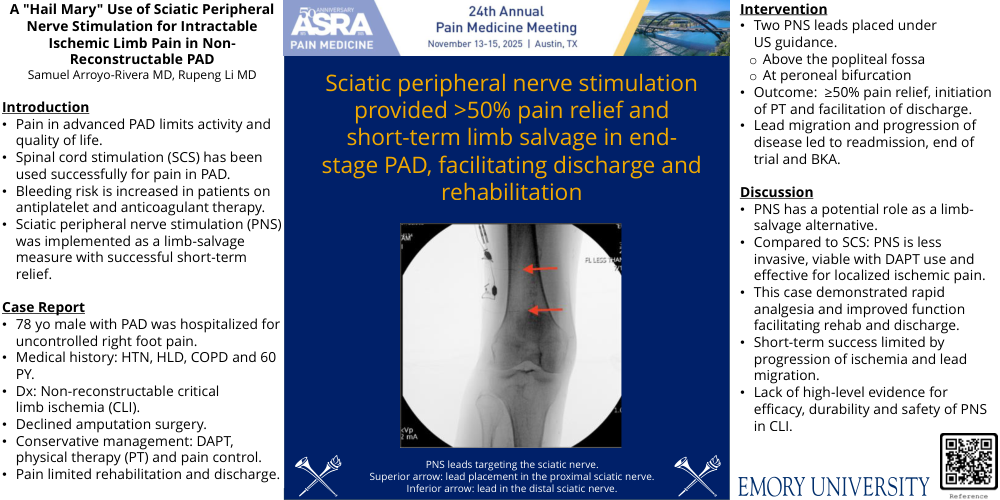
As a palliative intervention, two percutaneous peripheral nerve stimulation (PNS) leads were placed adjacent to the right sciatic nerve under ultrasound guidance: one above the popliteal fossa and a second at the peroneal bifurcation. Intraoperative testing produced paresthesia's in the calf and plantar foot without motor activation. The patient reported ≥50% pain relief, enabling discharge and initiation of physical therapy.
Ten days later, he returned with recurrent ischemic pain. Examination revealed cold, cyanotic right toes indicative of progression of ischemic disease. PNS leads were found nearly fully dislodged. The leads were removed in preparation forbelow the knee amputation with perioperativedual adductor canal and popliteal nerve blocks.
Discussion
PNS has demonstrated efficacy in chronic pain conditions and may offer a viable limb-salvage alternative for CLI patients without revascularization options. While SCS holds promise, its limitations make PNS a more viable patient withconcurrent management withDAPT.This PNS trial showed rapid pain relief and functional improvement. Limited collateral circulation and significant progression of ischemia interrupted the successful trial and placement of a permanent PNS.High-quality evidence is lacking and should be pursued.
Images

Fluoroscopic image showing peripheral nerve stimulation (PNS) leads targeting the sciatic nerve. The superior red arrow indicates the lead placement in the proximal sciatic nerve, while the inferior red arrow marks the lead in the distal sciatic nerve.
References
-
Seretny M, et al. Pain management in patients with vascular disease. Br J Anaesth. 2016;117(Suppl 2):ii95–ii106. doi:10.1093/bja/aew326
-
Gilmore CA, et al. Percutaneous 60-day peripheral nerve stimulation implant provides sustained relief of chronic pain following amputation: 12-month follow-up of a randomized, double-blind, placebo-controlled trial. Reg Anesth Pain Med. 2020;45(1):44–51. doi:10.1136/rapm-2019-100937
-
Helm S, et al. Peripheral nerve stimulation for chronic pain: a systematic review of effectiveness and safety. Pain Ther. 2021;10(3):985–1002. doi:10.1007/s40122-021-00306-4
-
Gazzeriet al. Spinal Cord Stimulation for Intractable Chronic Limb Ischemia: A Narrative Review. J Cardiovasc Dev Dis. 2024 Aug 26;11(9):260. doi: 10.3390/jcdd11090260. PMID: 39330318; PMCID: PMC11431887.