343 posters, 5 videos, 2 audios, 18 topics, 33 sessions, 263 authors, 202 institutions
ePostersLive by SciGen Technologies S.A. All rights reserved.
24th Annual Pain Medicine Meeting 2025
November 13-15, 2025| JW Marriott Austin, Austin, Texas

2190434
Intraoperative Ketamine Infusion for Perioperative and Chronic Pain Control in a Patient with Complex Regional Pain Syndrome
Poster Presenter
Part of Topic
Medically Challenging Cases
Background
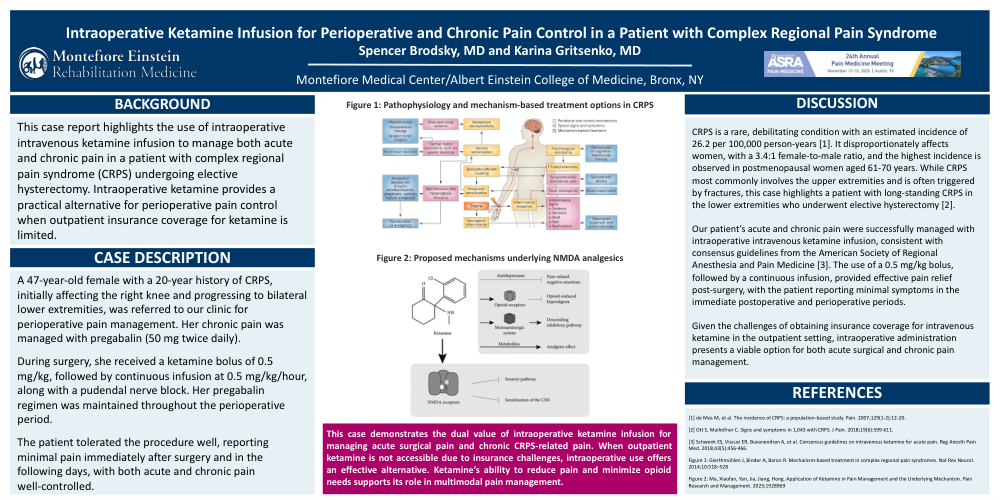
This case report highlights the use of intraoperative intravenous ketamine infusion to manage both acute and chronic pain in a patient with complex regional pain syndrome (CRPS) undergoing elective hysterectomy. Intraoperative ketamine provides a practical alternative for perioperative pain control when outpatient insurance coverage for ketamine is limited.
A 47-year-old female with a 20-year history of CRPS, initially affecting the right knee and progressing to bilateral lower extremities, was referred to our clinic for perioperative pain management. Her chronic pain was managed with pregabalin (50 mg twice daily).
During surgery, she received a ketamine bolus of 0.5 mg/kg, followed by continuous infusion at 0.5 mg/kg/hour, along with a pudendal nerve block. Her pregabalin regimen was maintained throughout the perioperative period.
The patient tolerated the procedure well, reporting minimal pain immediately after surgery and in the following days, with both acute and chronic pain well-controlled.
CRPS is a rare, debilitating condition with an estimated incidence of 26.2 per 100,000 person-years [1]. It disproportionately affects women, with a 3.4:1 female-to-male ratio, and the highest incidence is observed in postmenopausal women aged 61-70 years. While CRPS most commonly involves the upper extremities and is often triggered by fractures, this case highlights a patient with long-standing CRPS in the lower extremities who underwent elective hysterectomy [2].
Our patient’s acute and chronic pain were successfully managed with intraoperative intravenous ketamine infusion, consistent with consensus guidelines from the American Society of Regional Anesthesia and Pain Medicine [3]. The use of a 0.5 mg/kg bolus, followed by a continuous infusion, provided effective pain relief post-surgery, with the patient reporting minimal symptoms in the immediate postoperative and perioperative periods.
Given the challenges of obtaining insurance coverage for intravenous ketamine in the outpatient setting, intraoperative administration presents a viable option for both acute surgical and chronic pain management.
This case demonstrates the dual value of intraoperative ketamine infusion for managing acute surgical pain and chronic CRPS-related pain. When outpatient ketamine is not accessible due to insurance challenges, intraoperative use offers an effective alternative. Ketamine’s ability to reduce pain and minimize opioid needs supports its role in multimodal pain management.
[1] de Mos M, et al. The incidence of CRPS: a population-based study. Pain. 2007;129(1-2):12-20.
[2] Ott S, Maihöfner C. Signs and symptoms in 1,043 with CRPS. J Pain. 2018;19(6):599-611.
[3] Schwenk ES, Viscusi ER, Buvanendran A, et al. Consensus guidelines on intravenous ketamine for acute pain. Reg Anesth Pain Med. 2018;43(5):456-466.
Figure References:
Figure 1: Gierthmühlen J, Binder A, Baron R. Mechanism-based treatment in complex regional pain syndromes. Nat Rev Neurol. 2014;10:518–528
Figure 2: Ma, Xiaofan, Yan, Jia, Jiang, Hong. Application of Ketamine in Pain Management and the Underlying Mechanism. Pain Research and Management. 2023;1928969