343 posters, 5 videos, 2 audios, 18 topics, 33 sessions, 263 authors, 202 institutions
ePostersLive by SciGen Technologies S.A. All rights reserved.
24th Annual Pain Medicine Meeting 2025
November 13-15, 2025| JW Marriott Austin, Austin, Texas

2189827
Lumbar radiculopathy secondary to sacroplasty cement extravasation: a case report
Poster Presenter
Authors
Affiliations
Part of Topic
Medically Challenging Cases
Lumbar radiculopathy secondary to sacroplasty cement extravasation: a case report
Daniel Wang, DO1; Seyed Ali Mosotoufi, MD2
1Department of Physical Medicine and Rehabilitation, University of Miami Miller School of Medicine
INTRODUCTION
•Sacroplasty is an effective intervention for sacral insufficiency fractures
•It provides rapid pain relief and functional improvement.
•While radiographic cement leakage occurs in up to 19% of cases, symptomatic nerve root compression is rare but clinically significant.
•Prompt recognition and management of this complication are essential to prevent persistent neurological deficits.
•This case highlights the unique presentation and management of radiculopathy secondary to canal cement extravasation following sacroplasty.
ASSESSMENT/RESULTS
•71-year-old woman with a history of osteopenia and a recent left tibial plateau fracture presented with severe right low back pain.
•MRI revealed bilateral S1 sacral ala fractures with bone marrow edema.
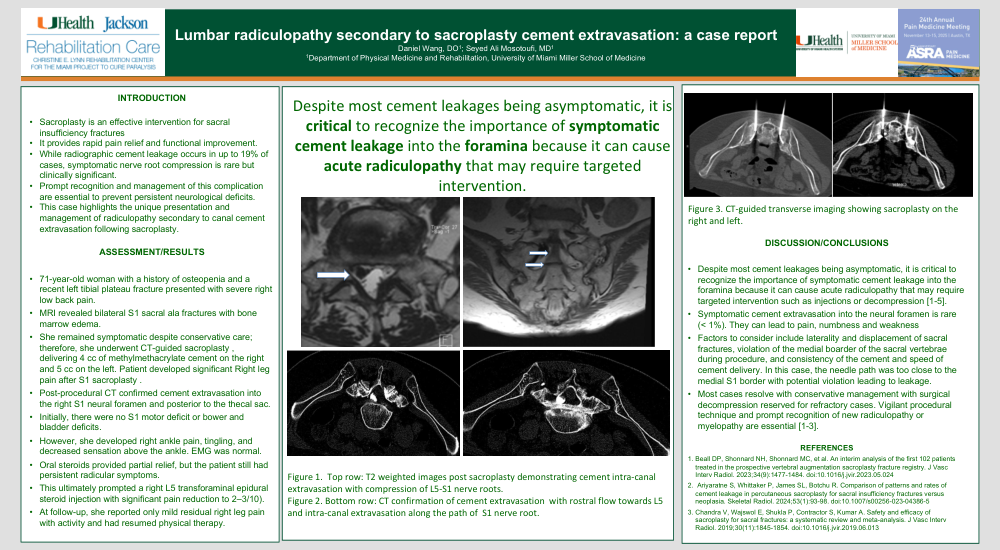
•She remained symptomatic despite conservative care; therefore, she underwent CT-guided sacroplasty , delivering 4 cc of methylmethacrylate cement on the right and 5 cc on the left. Patient developed significant Right leg pain after S1 sacroplasty .
•Post-procedural CT confirmed cement extravasation into the right S1 neural foramen and posterior to the thecal sac.
•Initially, there were no S1 motor deficit or bower and bladder deficits.
•However, she developed right ankle pain, tingling, and decreased sensation above the ankle. EMG was normal.
•Oral steroids provided partial relief, but the patient still had persistent radicular symptoms.
•This ultimately prompted a right L5 transforaminal epidural steroid injection with significant pain reduction to 2–3/10).
•At follow-up, she reported only mild residual right leg pain with activity and had resumed physical therapy.
DISCUSSION/CONCLUSIONS
•Despite most cement leakages being asymptomatic, it is critical to recognize the importance of symptomatic cement leakage into the foramina because it can cause acute radiculopathy that may require targeted intervention such as injections or decompression [1-5].
•Symptomatic cement extravasation into the neural foramen is rare (< 1%). They can lead to pain, numbness and weakness
•Factors to consider include laterality and displacement of sacral fractures, violation of the medial boarder of the sacral vertebrae during procedure, and consistency of the cement and speed of cement delivery. In this case, the needle path was too close to the medial S1 border with potential violation leading to leakage.
•Most cases resolve with conservative management with surgical decompression reserved for refractory cases. Vigilant procedural technique and prompt recognition of new radiculopathy or myelopathy are essential [1-3].
REFERENCES
1.Beall DP, Shonnard NH, Shonnard MC, et al. An interim analysis of the first 102 patients treated in the prospective vertebral augmentation sacroplasty fracture registry. J Vasc Interv Radiol. 2023;34(9):1477-1484. doi:10.1016/j.jvir.2023.05.024
2. Ariyaratne S, Whittaker P, James SL, Botchu R. Comparison of patterns and rates of cement leakage in percutaneous sacroplasty for sacral insufficiency fractures versus neoplasia. Skeletal Radiol. 2024;53(1):93-98. doi:10.1007/s00256-023-04386-5
3.Chandra V, Wajswol E, Shukla P, Contractor S, Kumar A. Safety and efficacy of sacroplasty for sacral fractures: a systematic review and meta-analysis. J Vasc Interv Radiol. 2019;30(11):1845-1854. doi:10.1016/j.jvir.2019.06.013