343 posters, 5 videos, 2 audios, 18 topics, 33 sessions, 263 authors, 202 institutions
ePostersLive by SciGen Technologies S.A. All rights reserved.
24th Annual Pain Medicine Meeting 2025
November 13-15, 2025| JW Marriott Austin, Austin, Texas

2186224
Collateral Cure: Resolution of Chronic Regional Pain Syndrome Symptoms After Spinal Cord Stimulator Reimplantation Complication
Poster Presenter
Authors
Affiliations
Part of Topic
Medically Challenging Cases
Introduction
Spinal cord stimulation (SCS) is an established therapy for chronic pain conditions such as complex regional pain syndrome (CRPS), post-laminectomy pain syndrome, and ischemic limb pain. SCS involves the placement of percutaneous electrodes into the epidural space. SCS implantation carries a complication risk, including infection, lead migration, and, rarely, spinal cord injury. Spinal cord injury following the implantation of paddle or percutaneous leads has a noted overall incidence of 0.42%.
Case Presentation
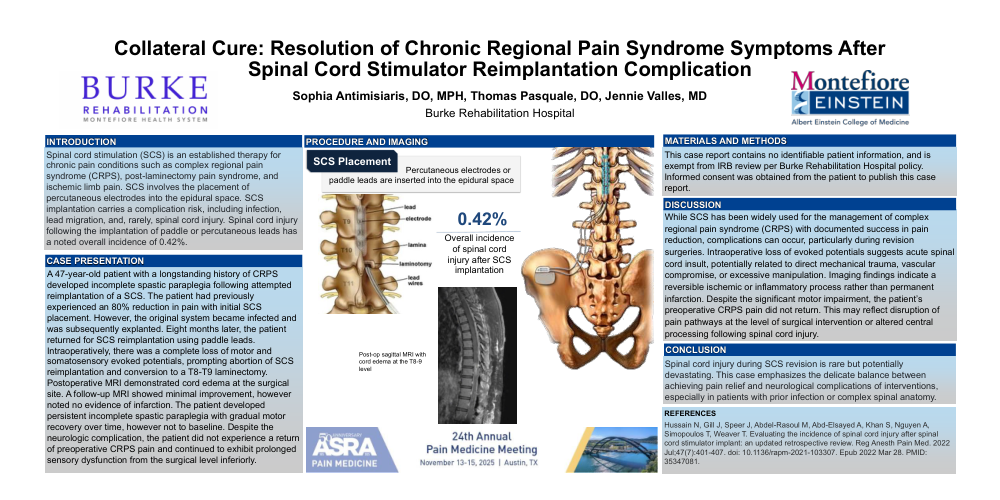
A 47-year-old patient with a longstanding history of CRPS developed incomplete spastic paraplegia following attempted reimplantation of a SCS. The patient had previously experienced an 80% reduction in pain with initial SCS placement. However, the original system became infected and was subsequently explanted. Eight months later, the patient returned for SCS reimplantation using paddle leads. Intraoperatively, there was a complete loss of motor and somatosensory evoked potentials, prompting abortion of SCS reimplantation and conversion to a T8-T9 laminectomy. Postoperative MRI demonstrated cord edema at the surgical site. A follow-up MRI showed minimal improvement, however noted no evidence of infarction. The patient developed persistent incomplete spastic paraplegia with gradual motor recovery over time, however not to baseline. Despite the neurologic complication, the patient did not experience a return of preoperative CRPS pain and continued to exhibit prolonged sensory dysfunction from the surgical level inferiorly.
Discussion
While SCS has been widely used for the management of complex regional pain syndrome (CRPS) with documented success in pain reduction, complications can occur, particularly during revision surgeries. Intraoperative loss of evoked potentials suggests acute spinal cord insult, potentially related to direct mechanical trauma, vascular compromise, or excessive manipulation. Imaging findings indicate a reversible ischemic or inflammatory process rather than permanent infarction. Despite the significant motor impairment, the patient’s preoperative CRPS pain did not return. This may reflect disruption of pain pathways at the level of surgical intervention or altered central processing following spinal cord injury.
Conclusion
Spinal cord injury during SCS revision is rare but potentially devastating. This case emphasizes the delicate balance between achieving pain relief and neurological complications of interventions, especially in patients with prior infection or complex spinal anatomy.