343 posters, 5 videos, 2 audios, 18 topics, 33 sessions, 263 authors, 202 institutions
ePostersLive by SciGen Technologies S.A. All rights reserved.
24th Annual Pain Medicine Meeting 2025
November 13-15, 2025| JW Marriott Austin, Austin, Texas

2184027
Peripheral Nerve Stimulation for Cervical Radiculopathy in the Setting of Overlapping Shoulder Osteoarthritis: A Case Report
Poster Presenter
Authors
Affiliations
Part of Topic
Medically Challenging Cases
Peripheral Nerve Stimulation For Cervical Radiculopathy In The Setting Of Overlapping Shoulder Osteoarthritis: A Case Report
Alan Shain, MD,1 Jeremy R. Benhamroun-Zbili, DO,2
1 Long Island Jewish Forest Hills Hospital, Queens, New York, USA.
2 Northwell Greenwich Village Hospital, New York, New York, USA.
BACKGROUND AND PURPOSE: Peripheral nerve stimulation (PNS), typically used for focal nerve pain, has emerging applications in complex pain syndromes such as shoulder pain via suprascapular or axillary nerve targeting.1,2 Its role in cervical radiculopathy remains limited, with spinal cord stimulation (SCS) preferred for multisegmental radicular pain.2,3 We present a novel case in which right-sided radial nerve PNS relieved C5-7 radicular pain and improved arm function in a nonsurgical patient with coexisting and overlapping severe shoulder osteoarthritis.
SETTING: Outpatient Physical Medicine and Rehabilitation Clinic
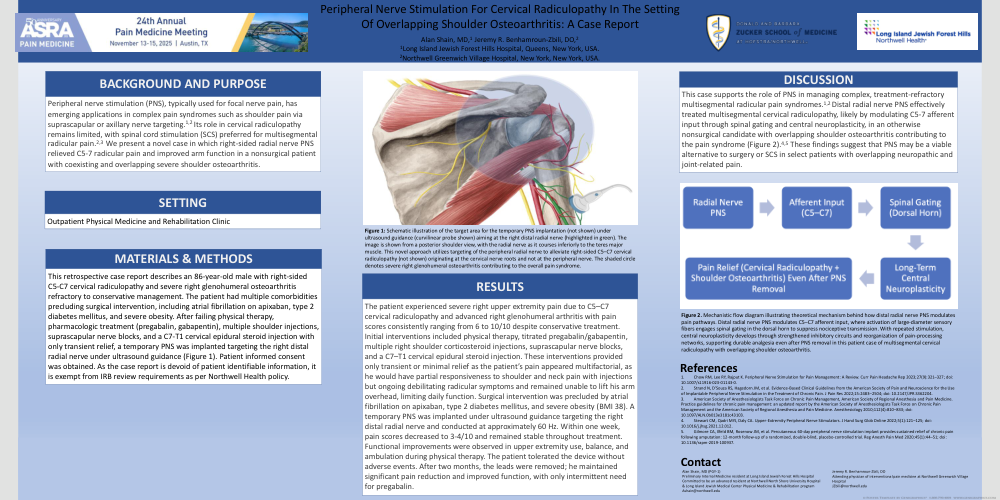
MATERIALS & METHODS: This retrospective case report describes an 86-year-old male with right-sided C5-C7 cervical radiculopathy and severe right glenohumeral osteoarthritis refractory to conservative management. The patient had multiple comorbidities precluding surgical intervention, including atrial fibrillation on apixaban, type 2 diabetes mellitus, and severe obesity. After failing physical therapy, pharmacologic treatment (pregabalin, gabapentin), multiple shoulder injections, suprascapular nerve blocks, and a C7-T1 cervical epidural steroid injection with only transient relief, a temporary PNS was implanted targeting the right distal radial nerve under ultrasound guidance (Figure 1). Patient informed consent was obtained. As the case report is devoid of patient identifiable information, it is exempt from IRB review requirements as per Northwell Health policy.
RESULTS: The patient experienced severe right upper extremity pain due to C5–C7 cervical radiculopathy and advanced right glenohumeral arthritis with pain scores consistently ranging from 6 to 10/10 despite conservative treatment. Initial interventions included physical therapy, titrated pregabalin/gabapentin, multiple right shoulder corticosteroid injections, suprascapular nerve blocks, and a C7–T1 cervical epidural steroid injection. These interventions provided only transient or minimal relief as the patient's pain appeared multifactorial, as he would have partial responsiveness to shoulder and neck pain with injections but ongoing debilitating radicular symptoms and remained unable to lift his arm overhead, limiting daily function. Surgical intervention was precluded by atrial fibrillation on apixaban, type 2 diabetes mellitus, and severe obesity (BMI 38). A temporary PNS was implanted under ultrasound guidance targeting the right distal radial nerve and conducted at approximately 60 Hz. Within one week, pain scores decreased to 3-4/10 and remained stable throughout treatment. Functional improvements were observed in upper extremity use, balance, and ambulation during physical therapy. The patient tolerated the device without adverse events. After two months, the leads were removed; he maintained significant pain reduction and improved function, with only intermittent need for pregabalin.
DISCUSSION: This case supports the role of PNS in managing complex, treatment-refractory multisegmental radicular pain syndromes.1,2 Distal radial nerve PNS effectively treated multisegmental cervical radiculopathy, likely by modulating C5-7 afferent input through spinal gating and central neuroplasticity, in an otherwise nonsurgical candidate with overlapping shoulder osteoarthritis contributing to the pain syndrome (Figure 2).4,5 These findings suggest that PNS may be a viable alternative to surgery or SCS in select patients with overlapping neuropathic and joint-related pain.
References
1. Chow RM, Lee RY, Rajput K. Peripheral Nerve Stimulation for Pain Management: A Review. Curr Pain Headache Rep 2023;27(9):321–327; doi: 10.1007/s11916-023-01143-0.
2. Strand N, D’Souza RS, Hagedorn JM, et al. Evidence-Based Clinical Guidelines from the American Society of Pain and Neuroscience for the Use of Implantable Peripheral Nerve Stimulation in the Treatment of Chronic Pain. J Pain Res 2022;15:2483–2504; doi: 10.2147/JPR.S362204.
3. American Society of Anesthesiologists Task Force on Chronic Pain Management, American Society of Regional Anesthesia and Pain Medicine. Practice guidelines for chronic pain management: an updated report by the American Society of Anesthesiologists Task Force on Chronic Pain Management and the American Society of Regional Anesthesia and Pain Medicine. Anesthesiology 2010;112(4):810–833; doi: 10.1097/ALN.0b013e3181c43103.
4. Stewart CM, Qadri MYJ, Daly CA. Upper-Extremity Peripheral Nerve Stimulators. J Hand Surg Glob Online 2022;5(1):121–125; doi: 10.1016/j.jhsg.2021.12.012.
5. Gilmore CA, Ilfeld BM, Rosenow JM, et al. Percutaneous 60-day peripheral nerve stimulation implant provides sustained relief of chronic pain following amputation: 12-month follow-up of a randomized, double-blind, placebo-controlled trial. Reg Anesth Pain Med 2020;45(1):44–51; doi: 10.1136/rapm-2019-100937.