343 posters, 5 videos, 2 audios, 18 topics, 33 sessions, 263 authors, 202 institutions
ePostersLive by SciGen Technologies S.A. All rights reserved.
24th Annual Pain Medicine Meeting 2025
November 13-15, 2025| JW Marriott Austin, Austin, Texas

2183801
Managing Hip Arthroplasty with Regional Anesthesia in Patient with Severe Sarcoidosis and Cardiac Dysfunction
Poster Presenter
Part of Topic
Medically Challenging Cases
Introduction
•Patients with left ventricular ejection fraction (LVEF) < 30% and pulmonary hypertension (RVSP > 50 mmHg) are at high perioperative risk due to limited cardiopulmonary reserve and poor tolerance to anesthetic-induced hypotension (2, 3).
•General anesthesia (GA) can precipitate hemodynamic collapse, right-heart failure, or postoperative respiratory failure (2, 3).
•Single-shot spinal anesthesia provides rapid, dense blockade but carries risk of abrupt sympathectomy and hypotension, which may be poorly tolerated in patients with compromised ventricular function (3).
•Continuous spinal anesthesia (CSA) allows graded, titratable intrathecal dosing, offering greater control of sympathetic blockade and hemodynamic stability compared with single-shot techniques (1).
•Regional adjuncts such as the pericapsular nerve group (PENG) block enhance analgesia and reduce systemic opioid use, thereby avoiding respiratory depression in patients with pulmonary disease (2, 3).
•Combined CSA with a PENG block provides a balanced anesthetic: stable, opioid-sparing, and tailored for high-risk orthopedic patients (1–3).
Case Report
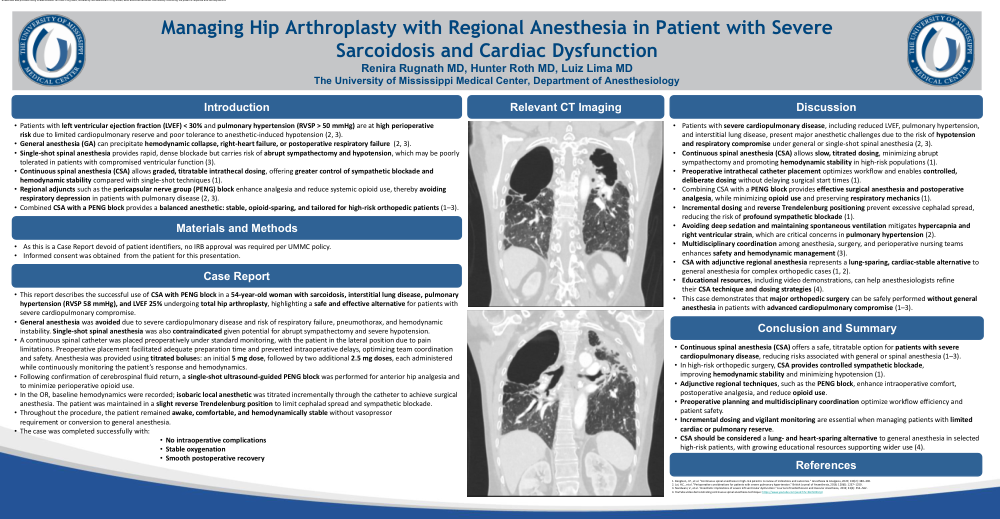
•This report describes the successful use of CSA with PENG block in a 54-year-old woman with sarcoidosis, interstitial lung disease, pulmonary hypertension (RVSP 58 mmHg), and LVEF 25% undergoing total hip arthroplasty, highlighting a safe and effective alternative for patients with severe cardiopulmonary compromise.
•General anesthesia was avoided due to severe cardiopulmonary disease and risk of respiratory failure, pneumothorax, and hemodynamic instability. Single-shot spinal anesthesia was also contraindicated given potential for abrupt sympathectomy and severe hypotension.
•A continuous spinal catheter was placed preoperatively under standard monitoring, with the patient in the lateral position due to pain limitations. Preoperative placement facilitated adequate preparation time and prevented intraoperative delays, optimizing team coordination and safety. Anesthesia was provided using titrated boluses: an initial 5 mg dose, followed by two additional 2.5 mg doses, each administered while continuously monitoring the patient’s response and hemodynamics.
•Following confirmation of cerebrospinal fluid return, a single-shot ultrasound-guided PENG block was performed for anterior hip analgesia and to minimize perioperative opioid use.
•In the OR, baseline hemodynamics were recorded; isobaric local anesthetic was titrated incrementally through the catheter to achieve surgical anesthesia. The patient was maintained in a slight reverse Trendelenburg position to limit cephalad spread and sympathetic blockade.
•Throughout the procedure, the patient remained awake, comfortable, and hemodynamically stable without vasopressor requirement or conversion to general anesthesia.
•The case was completed successfully with:
•No intraoperative complications
•Stable oxygenation
•Smooth postoperative recovery
Discussion
•Patients with severe cardiopulmonary disease, including reduced LVEF, pulmonary hypertension, and interstitial lung disease, present major anesthetic challenges due to the risk of hypotension and respiratory compromise under general or single-shot spinal anesthesia (2, 3).
•Continuous spinal anesthesia (CSA) allows slow, titrated dosing, minimizing abrupt sympathectomy and promoting hemodynamic stability in high-risk populations (1).
•Preoperative intrathecal catheter placement optimizes workflow and enables controlled, deliberate dosing without delaying surgical start times (1).
•Combining CSA with a PENG block provides effective surgical anesthesia and postoperative analgesia, while minimizing opioid use and preserving respiratory mechanics (1).
•Incremental dosing and reverse Trendelenburg positioning prevent excessive cephalad spread, reducing the risk of profound sympathetic blockade (1).
•Avoiding deep sedation and maintaining spontaneous ventilation mitigates hypercapnia and right ventricular strain, which are critical concerns in pulmonary hypertension (2).
•Multidisciplinary coordination among anesthesia, surgery, and perioperative nursing teams enhances safety and hemodynamic management (3).
•CSA with adjunctive regional anesthesia represents a lung-sparing, cardiac-stable alternative to general anesthesia for complex orthopedic cases (1, 2).
•Educational resources, including video demonstrations, can help anesthesiologists refine their CSA technique and dosing strategies (4).
•This case demonstrates that major orthopedic surgery can be safely performed without general anesthesia in patients with advanced cardiopulmonary compromise (1–3).
Conclusion
•Continuous spinal anesthesia (CSA) offers a safe, titratable option for patients with severe cardiopulmonary disease, reducing risks associated with general or spinal anesthesia (1–3).
•In high-risk orthopedic surgery, CSA provides controlled sympathetic blockade, improving hemodynamic stability and minimizing hypotension (1).
•Adjunctive regional techniques, such as the PENG block, enhance intraoperative comfort, postoperative analgesia, and reduce opioid use.
•Preoperative planning and multidisciplinary coordination optimize workflow efficiency and patient safety.
•Incremental dosing and vigilant monitoring are essential when managing patients with limited cardiac or pulmonary reserve.
•CSA should be considered a lung- and heart-sparing alternative to general anesthesia in selected high-risk patients, with growing educational resources supporting wider use (4).