343 posters, 5 videos, 2 audios, 18 topics, 33 sessions, 263 authors, 202 institutions
ePostersLive by SciGen Technologies S.A. All rights reserved.
24th Annual Pain Medicine Meeting 2025
November 13-15, 2025| JW Marriott Austin, Austin, Texas

2176788
Contrast Spread for Diagnostic Medial Branch Blocks
Poster Presenter
Authors
Affiliations
Part of Topic
Medically Challenging Cases
Contrast Spread for Diagnostic Medial Branch Blocks
Introduction
The diagnostic specificity of lumbar medial branch blocks (MBBs) can be affected by injectate volume. Prior studies support the use of smaller volumes to avoid confounding diagnostic outcomes and reduce the risk of complications such as inadvertent epidural or intravascular spread. 1-4 We present a case with fluoroscopic imaging that demonstrates how adjusting contrast volume impacts diagnostic accuracy in facet-mediated low back pain.
Materials and Methods
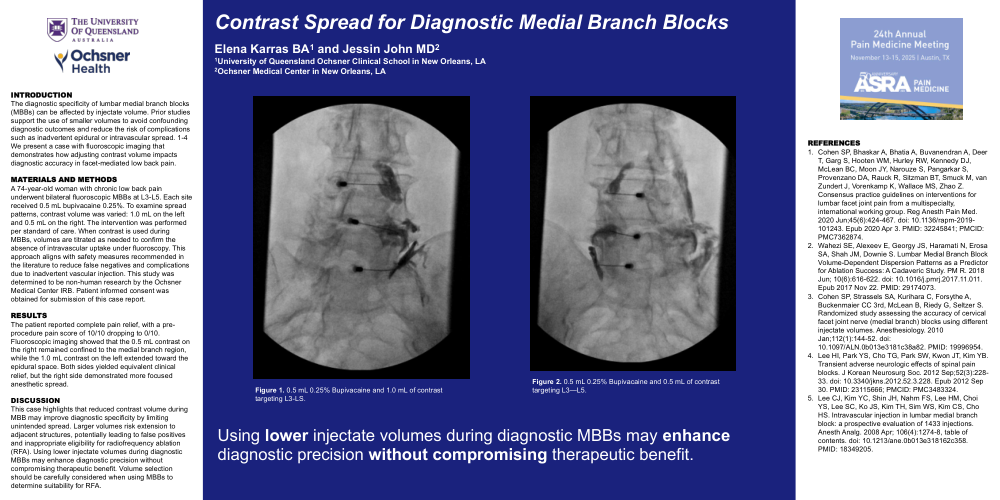
A 74-year-old woman with chronic low back pain underwent bilateral fluoroscopic MBBs at L3–L5. Each site received 0.5 mL bupivacaine 0.25%. To examine spread patterns, contrast volume was varied: 1.0 mL on the left and 0.5 mL on the right. The intervention was performed per standard of care. When contrast is used during MBBs, volumes are titrated as needed to confirm the absence of intravascular uptake under fluoroscopy. This approach aligns with safety measures recommended in the literature to reduce false negatives and complications due to inadvertent vascular injection. 5 This study was determined to be non-human research by the Ochsner Medical Center IRB. Patient informed consent was obtained for submission of this case report.
Results/Case Report
The patient reported complete pain relief, with a pre-procedure pain score of 10/10 dropping to 0/10. Fluoroscopic imaging showed that the 0.5 mL contrast on the right remained confined to the medial branch region, while the 1.0 mL contrast on the left extended toward the epidural space. Both sides yielded equivalent clinical relief, but the right side demonstrated more focused anesthetic spread.
Discussion
This case highlights that reduced contrast volume during MBB may improve diagnostic specificity by limiting unintended spread. Larger volumes risk extension to adjacent structures, potentially leading to false positives and inappropriate eligibility for radiofrequency ablation (RFA). Using lower injectate volumes during diagnostic MBBs may enhance diagnostic precision without compromising therapeutic benefit. Volume selection should be carefully considered when using MBBs to determine suitability for RFA.