343 posters, 5 videos, 2 audios, 18 topics, 33 sessions, 263 authors, 202 institutions
ePostersLive by SciGen Technologies S.A. All rights reserved.
24th Annual Pain Medicine Meeting 2025
November 13-15, 2025| JW Marriott Austin, Austin, Texas

2176101
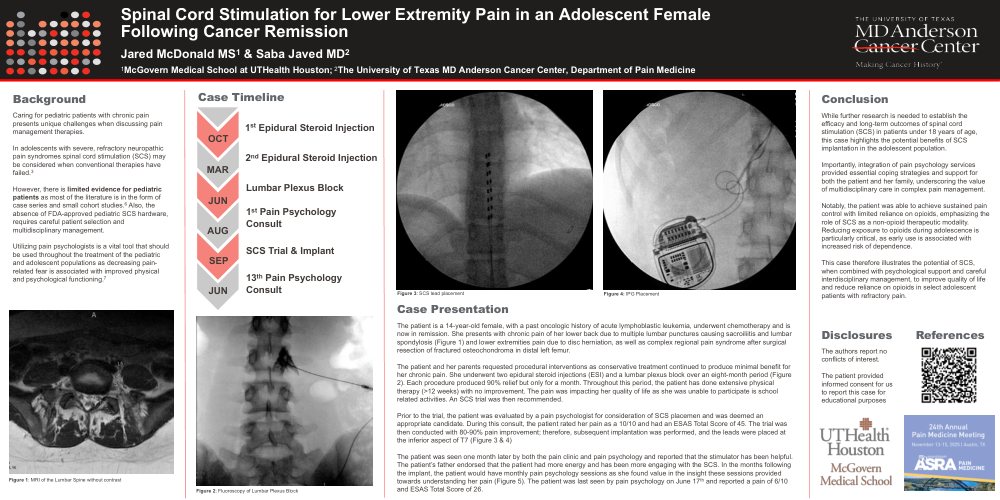
Spinal Cord Stimulation for Lower Extremity Pain in an Adolescent Female Following Cancer Remission: A Case Report
Poster Presenter
Authors
Affiliations
Part of Topic
Medically Challenging Cases
Spinal Cord Stimulation for Lower Extremity Pain in an Adolescent Female Following Cancer Remission
Jared McDonald MS & Saba Javed MD
McGovern Medical School at UTHealth Houston; The University of Texas MD Anderson Cancer Center, Department of Pain Medicine
Background
Caring for pediatric patients with chronic pain presents unique challenges when discussing pain management therapies. In adolescents with severe, refractory neuropathic pain syndromes spinal cord stimulation (SCS) may be considered when conventional therapies have failed.3 However, there is limited evidence for pediatric patients as most of the literature is in the form of case series and small cohort studies.6 Also, the absence of FDA-approved pediatric SCS hardware, requires careful patient selection and multidisciplinary management. Utilizing pain psychologists is a vital tool that should be used throughout the treatment of the pediatric and adolescent populations as decreasing pain-related fear is associated with improved physical and psychological functioning.7
Case Presentation
The patient is a 14-year-old female, with a past oncologic history of acute lymphoblastic leukemia, underwent chemotherapy and is now in remission. She presents with chronic pain of her lower back due to multiple lumbar punctures causing sacroiliitis and lumbar spondylosis (Figure 1) and lower extremities pain due to disc herniation, as well as complex regional pain syndrome after surgical resection of fractured osteochondroma in distal left femur. The patient and her parents requested procedural interventions as conservative treatment continued to produce minimal benefit for her chronic pain. She underwent two epidural steroid injections (ESI) and a lumbar plexus block over an eight-month period (Figure 2). Each procedure produced 90% relief but only for a month. Throughout this period, the patient has done extensive physical therapy (>12 weeks) with no improvement. The pain was impacting her quality of life as she was unable to participate is school related activities. An SCS trial was then recommended. Prior to the trial, the patient was evaluated by a pain psychologist for consideration of SCS placemen and was deemed an appropriate candidate. During this consult, the patient rated her pain as a 10/10 and had an ESAS Total Score of 45. The trial was then conducted with 80-90% pain improvement; therefore, subsequent implantation was performed, and the leads were placed at the inferior aspect of T7 (Figure 3 & 4) The patient was seen one month later by both the pain clinic and pain psychology and reported that the stimulator has been helpful. The patient’s father endorsed that the patient had more energy and has been more engaging with the SCS. In the months following the implant, the patient would have monthly pain psychology sessions as she found value in the insight these sessions provided towards understanding her pain (Figure 5). The patient was last seen by pain psychology on June 17th and reported a pain of 6/10 and ESAS Total Score of 26.
Conclusion
While further research is needed to establish the efficacy and long-term outcomes of spinal cord stimulation (SCS) in patients under 18 years of age, this case highlights the potential benefits of SCS implantation in the adolescent population. Importantly, integration of pain psychology services provided essential coping strategies and support for both the patient and her family, underscoring the value of multidisciplinary care in complex pain management. Notably, the patient was able to achieve sustained pain control with limited reliance on opioids, emphasizing the role of SCS as a non-opioid therapeutic modality. Reducing exposure to opioids during adolescence is particularly critical, as early use is associated with increased risk of dependence. This case therefore illustrates the potential of SCS, when combined with psychological support and careful interdisciplinary management, to improve quality of life and reduce reliance on opioids in select adolescent patients with refractory pain.