425 posters, 1 videos, 9 audios, 8 topics, 53 sessions, 340 authors, 286 institutions
ePostersLive by SciGen Technologies S.A. All rights reserved.
22nd Annual Pain Medicine Meeting 2023
November 10 - 11, 2023 | New Orleans Marriott | New Orleans, Louisiana, USA

4953
OPIOID POST-CESAREAN PAIN MANAGEMENT IN THE CONTEXT OF PRECISION DOSING: A SYSTEMATIC REVIEW
Poster Presenter
Authors
Affiliations
Part of Topic
Acute Pain
Opioid post-cesarean pain management in the context of precision dosing: a systematic review
INTRODUCTION
- Cesarean section (CS) is one of the most significant surgical interventions and stands as the main cause of intense postoperative pain
- Literature diverges on the efficacy and modalities of opioid analgesia
- We aim to evaluate the current procedures and dosages of commonly used opioids and adjuvants, addressing novel perspectives of individualized care for post-cesarean pain
RESULTS
- Patients between 16 and 45 years old were evaluated
- Greater efficiency of Intrathecal Morphine (IM), when compared or associated with the Transversus Abdominis Plane (TAP) block and the Posterior Quadratus Lumborum (PQL) block
- The lowest dose possible mitigates the adverse effects and ensures efficient pain relief
- The increase in adjuvant NSAIDs doses can lead to a decreased opioid dose, maintaining similar pain scores
- Specific health conditions may require higher opioid dosages
DISCUSSION
- Association of NSAIDs and opioids can be a reliable way to enhance outcomes, as shown by the promising synergistic combination of pentazocine and diclofenac
- Optimal post-CS pain management for women is crucial to ensure their well-being, prognosis, adequate breastfeeding, and shorter hospital stays, benefiting both patients and the healthcare system
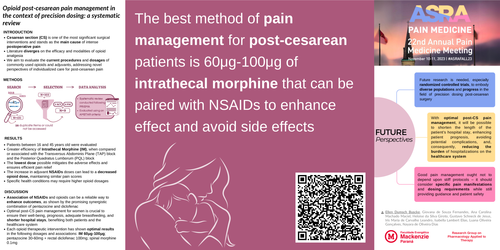
- Each opioid therapeutic intervention has shown optimal results in the following dosages and associations: IM 60μg-100μg; pentazocine 30-60mg + rectal diclofenac 100mg; spinal morphine 0.1mg
FUTURE PERSPECTIVES
Future research is needed, especially randomized controlled trials, to embody diverse populations and progress in the field of precision dosing post-cesarean surgery.
With optimal post-CS pain management, it will be possible to shorten the length of the patient's hospital stay, enhancing patient prognosis, avoiding potential complications, and, consequently, reducing the burden of hospitalizations on the healthcare system
Good pain management ought not to depend upon stiff protocols – it should consider specific pain manifestations and dosing requirements while still providing guidance and patient safety