425 posters, 1 videos, 9 audios, 8 topics, 53 sessions, 340 authors, 286 institutions
ePostersLive by SciGen Technologies S.A. All rights reserved.
22nd Annual Pain Medicine Meeting 2023
November 10 - 11, 2023 | New Orleans Marriott | New Orleans, Louisiana, USA

4776
INTERCOSTAL NERVE BLOCKS WITH LIPOSOMAL OR PLAIN BUPIVACAINE VS THORACIC PARAVERTEBRAL NERVE BLOCK FOR VATS: PRELIMINARY RESULTS
Poster Presenter
Authors
Affiliations
Part of Topic
Acute Pain
Intercostal Nerve Blocks with Liposomal or plain Bupivacaine vs Thoracic Paravertebral Nerve Block for VATS: Preliminary Results
Fang Yu1,2, Ismat Mrad1,3, Muhammad Shabsigh1, Saman Yaghoubian1, Tracy Weigel4 & Jeff L. Xu1
1Department of Anesthesiology, Westchester Medical Center New York Medical College, Valhalla, NY
2Department of Neurology, Westchester Medical Center New York Medical College, Valhalla, NY
3Department of Anesthesiology and Perioperative Medicine, University of Rochester Medical Center, Rochester, NY
4Department of Thoracic Surgery, Westchester Medical Center New York Medical College, Valhalla, NY
Introduction:
Thoracic paravertebral (TPVB) and intercostal nerve block (ICNB) have been applied for postoperative pain control in patients undergoing video-assisted thoracoscopic surgery (VATS). [1,2] Liposomal bupivacaine (LB) is a long-acting local anesthetic that could provide pain relief for up to 72 hours based on some studies. [1,3,4] Our study is to examine the analgesic effects of continuous TPVB, ICNB with LB and plain bupivacaine (B).
Material and Methods:
This ongoing study is approved by Institutional Review Boards (IRBs) New York Medical College (protocol ID: 14010). Informed consent was obtained by Regional Anesthesia or Surgical Team before surgery. Randomization was performed by computer software and the result was declared at the time of surgical incision. Patients undergoing VATS surgery were included in the study. Exclusion criteria were 1) age < 18 yrs; 2) history of opioid use disorder or other illicit drug use; 3) history of VATS or thoracotomy in the past; 4) end stage liver or kidney dysfunction; 5) pregnancy and 6) patient refusal. Eligible patients were randomly assigned to three groups. Group A-ICNB-LB: 20ml liposomal bupivacaine 1.33% mixed with 20ml 0.25% bupivacaine HCl split between 4-5 intercostal nerves at the discretion of the surgical team to cover the surgical incisions and chest tube(s). Group B-TPVB: Regional Anesthesia or Acute Pain Service place two TPVB catheters to cover surgical incisions and chest tube(s) after a bolus of 10-20ml 0.25% bupivacaine HCl for each. Group C-ICBN-B: same injection approach as group A with 40ml 0.25% bupivacaine HCl. Postoperative Numerical Rating Scale (NRS), opioid consumption (morphine milligram equivalent, MME), time to first rescue opioid, side effects such as nausea or vomiting were recorded for further analysis. Mixed model or two-way ANOVA repeated measurement was used to compare postop pain score and opioid use at different time points among these three groups. One-way ANOVA or Kruska -Wallis H test was used to compare the time for first rescue opioid and other demographic data depending on data distribution.
Results:
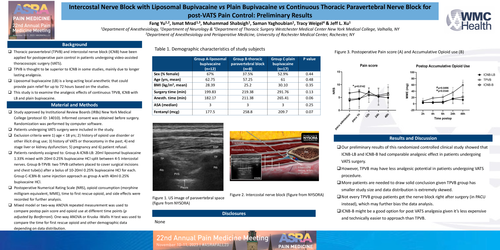
To date, a total of 43 patients were included in study. Four patients excluded due to change of surgical approach, 1 remained intubated after surgery and 1 patient refused to participate after surgery. Therefore, 37 patients eligible for further analysis (group A: 12, group B: 8 and group C: 17). The demographic data is shown in table 1. All three groups had comparable NRS scores from PACU admission to 48-h postop, except for 1h postop in PACU stay where TPVB patients had higher NRS (p=0.0142, Figure 1). For postop opioid use, there is significant difference of MME consumption among three groups (p=0.0078, Figure 2), and specifically at postop 6h, TPVB group had significantly higher use of opioids than the other two ICNB groups (p=0.0348 vs ICNB-B, p=0.0496 vs ICNB-LB). No difference for the time for first rescue opioid use (p>0.05). Postoperative nausea and vomiting (PONV) are comparable among three groups (p>0.05).
Discussion:
Our preliminary results of this randomized controlled clinical study showed that ICNB-LB and ICNB-B had similar analgesic effect, while TPVB may have less analgesic potential in patients undergoing VATS procedure. However, more patients are needed to draw solid conclusion given TPVB group has smaller study size and data distribution is extremely skewed. Furthermore, some TPVB group patients didn’t get the nerve block right after surgery (in PACU instead), which may also bias the data.
Table and Images:
Table 1: Demographic data of study subjects
|
|
Group A-liposomal bupivacaine |
Group B-thoracic paravertebral block |
Group C-plain bupivacaine |
P values |
|
Sex (% female) |
67% |
37.5% |
52.9% |
0.44 |
|
Age (yrs, mean) |
62.75 |
57.25 |
61 |
0.48 |
|
BMI (kg/m2, mean) |
28.39 |
25.2 |
30.10 |
0.35 |
|
Surgical duration (min) |
199.83 |
219.38 |
291.76 |
0.13 |
|
Anesthesia duration (min) |
182.17 |
211.38 |
265.41 |
0.06 |
|
ASA status (median) |
3 |
3 |
3 |
0.25 |
|
Intraoperative fentanyl (mcg) |
177.5 |
258.8 |
209.7 |
0.07 |
BMI: Body Mass Index
ASA: American Society of Anesthesiologists
Figure 1: Numerical Rating Scale over time for three groups. *p<0.05 by multiple comparison (TPVB vs ICNB-B). ICNB-LB: intercostal nerve block-liposomal bupivacaine; ICNB-B: intercostal nerve block-bupivacaine; TPVB: thoracic paravertebral nerve block. Data presented as median and interquartile range.
Figure 2: Accumulative opioid use following surgery. *p<0.05 and #p<0.05 by multiple comparison (TPVB vs ICNB-B and TPVB vs ICNB-LB, respectively). ICNB-LB: intercostal nerve block-liposomal bupivacaine; ICNB-B: intercostal nerve block-bupivacaine; TPVB: thoracic paravertebral nerve block. Data presented as median and interquartile range.
Reference:
[1] NeMoyer, R. et al., Paravertebral nerve block with liposomal bupivacaine for pain control following video-assisted thoracoscopic surgery and thoracotomy. J Surg Res, 2020
[2] Ahmed, Z. et al., Role of intercostal nerve block in reducing postoperative pain following video-assisted thoracoscopy: a randomized controlled trial. Saud J Anaesth, 2017
[3] Artz, C. et al., Intraoperative liposomal bupivacaine for skin graft donor site analgesia: a retrospective cohort study. Burns, 2021
[4] Krupp, R. et al., Liposomal bupivacaine nerve block provides better pain control post-total shoulder arthroplasty than continuous indwelling catheter. Arch Orthop Trauma Surg, 2023
Disclosures:
No