425 posters, 1 videos, 9 audios, 8 topics, 53 sessions, 340 authors, 286 institutions
ePostersLive by SciGen Technologies S.A. All rights reserved.
22nd Annual Pain Medicine Meeting 2023
November 10 - 11, 2023 | New Orleans Marriott | New Orleans, Louisiana, USA

5005
EARLY DIAGNOSIS AND MANAGEMENT OF COMPLEX REGIONAL PAIN SYNDROME TYPE II IN AN ADOLESCENT PATIENT
Poster Presenter
Authors
Affiliations
Part of Topic
Acute Pain
Medically Challenging Case: Early Diagnosis and Management of Complex Regional Pain Syndrome Type II in an Adolescent Patient Van T. Nguyen DO, Sydney Klugman MS4, Vandana Sharma MD
Introduction
Complex regional pain syndrome (CRPS) is an increasingly studied phenomenon secondary to interrelated mechanisms of vasomotor dysfunction, maladaptive neuroplasticity, and inflammation. It is notoriously difficult to treat, having significant impacts on quality of life and function. This debilitating syndrome is frequently characterized by a constellation of symptoms which include swelling, erythema, pain, allodynia, hyperalgesia, temperature irregularities, and/or motor dysfunction. Herein, we report a case of CRPS type 2 in an adolescent patient and the results of prompt diagnosis and aggressive early treatment.
Materials and Methods: Patient and patient’s mother have given their informed consent for submission of this case report. As this case report is devoid of patient identifiable information, it is exempt from IRB review requirements as per Upstate IRB review policy
Case Report
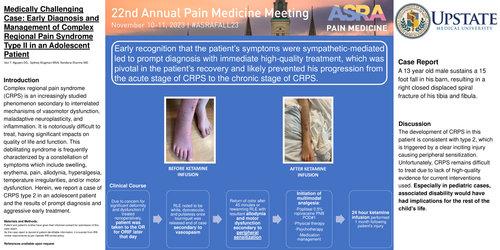
A 13 year old male sustains a 15 foot fall in his barn, resulting in a right closed displaced spiral fracture of his tibia and fibula
Clinical Course
Due to concern for significant deformity and dysfunction if treated nonoperatively, patient was taken to the OR for ORIF later that day.
RLE noted to be white, dysvascular, and pulseless once tourniquet was released end of case secondary to vasospasm.
Return of color after 45 minutes or rewarming RLE with resultant allodynia and motor dysfunction secondary to peripheral sensitization.
Initiation of multimodal analgesia: -Popliteal 0.5% ropivacaine PNB POD#1 -Physical therapy -Psychotherapy -Medication management
24 hour ketamine infusion performed 1 month following patient’s injury.
Discussion
The development of CRPS in this patient is consistent with type 2, which is triggered by a clear inciting injury causing peripheral sensitization. Unfortunately, CRPS remains difficult to treat due to lack of high-quality evidence for current interventions used. Especially in pediatric cases, associated disability would have had implications for the rest of the child’s life.
Early recognition that the patient’s symptoms were sympathetic-mediated led to prompt diagnosis with immediate high-quality treatment, which was pivotal in the patient’s recovery and likely prevented his progression from the acute stage of CRPS to the chronic stage of CRPS.