425 posters, 1 videos, 9 audios, 8 topics, 53 sessions, 340 authors, 286 institutions
ePostersLive by SciGen Technologies S.A. All rights reserved.
22nd Annual Pain Medicine Meeting 2023
November 10 - 11, 2023 | New Orleans Marriott | New Orleans, Louisiana, USA

4598
INSIGHTS ON THE OPERATIONAL AND FINANCIAL CONSIDERATIONS OF IMPLEMENTING A TRANSITIONAL PAIN SERVICE
Poster Presenter
Authors
Affiliations
Part of Topic
Acute Pain
Insights on the Operational and Financial Considerations of Implementing a Transitional Pain Service
Introduction
- More than one in five patients presenting for surgery have preoperative use of opioids.
- This population has more complications and utilizes more healthcare resources for their pain-related needs in the postoperative period.
- Several institutions have responded by adopting a transitional pain service (TPS), which aims to optimize patients by providing management of pain regimens beginning in the pre-operative period and continuing throughout the post-operative period.
Methods
- Semi-structured interviews were conducted with 27 stakeholders representing diverse service lines at Michigan Medicine, directors of TPS programs globally, and health economists.
- Qualitative and quantitative insights were collected on the current state of TPS programs as well as the pre-operative opioid-using population more generally.
- A literature review was conducted to further support the anecdotal evidence.
Results
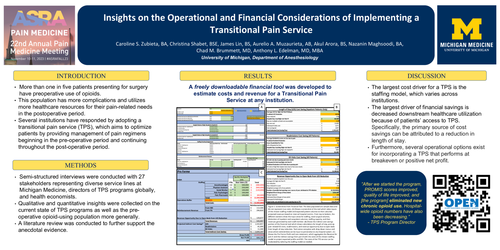
- A freely downloadable financial tool was developed to estimate costs and revenue for a Transitional Pain Service at any institution.
Discussion
- The largest cost driver for a TPS is the staffing model, which varies across institutions.
- The largest driver of financial savings is decreased downstream healthcare utilization because of patients’ access to TPS. Specifically, the primary source of cost savings can be attributed to a reduction in length of stay.
- Furthermore, several operational options exist for incorporating a TPS that performs at breakeven or positive net profit.
Quotes
- ”After we started the program, PROMIS scores improved, quality of life improved, and [the program] eliminated new chronic opioid use in patients who have been satisfied with their care. Also, hospital-wide opioid numbers have been decreasing the last two years.” - TPS Program Director