425 posters, 1 videos, 9 audios, 8 topics, 53 sessions, 340 authors, 286 institutions
ePostersLive by SciGen Technologies S.A. All rights reserved.
22nd Annual Pain Medicine Meeting 2023
November 10 - 11, 2023 | New Orleans Marriott | New Orleans, Louisiana, USA

4655
CANNABIS USE AND ACUTE POSTOPERATIVE PAIN OUTCOMES IN OLDER ADULTS: A PROPENSITY SCORE MATCHED RETROSPECTIVE COHORT STUDY
Poster Presenter
Authors
Affiliations
Part of Topic
Acute Pain
Cannabis Use and Acute Postoperative Pain Outcomes in Older Adults: A Propensity Score Matched Retrospective Cohort Study
Ruba Sajdeya, MD1; Masoud Rouhizadeh, PhD, MSc, MA2; Robert L. Cook, MD, MPH1; Ronald L. Ison, MS, PMP4; Chen Bai, MSc3; Sebastian Jugl, BPharm2; Hanzhi Gao, PhD, MS5; Mamoun T. Mardini, PhD3; Osama Dasa, MD, MPH1; Kimia Zandbiglari, MS2; Farzana I. Adiba, MS2; Almut G. Winterstein, RPh, PhD2; Catherine C. Price, PhD6; Thomas A. Pearson, MD, MPH, PhD1; Christoph N. Seubert, MD, PhD4; Patrick J. Tighe MD, MS.4
1 Department of Epidemiology, College of Public Health & Health Professions & College of Medicine, University of Florida, Gainesville, FL, USA.
2 Center for Drug Evaluation and Safety (CoDES), Department of Pharmaceutical Outcomes & Policy, University of Florida, Gainesville, FL, USA.
3 Department of Health Outcomes & Biomedical Informatics, College of Medicine, University of Florida, Gainesville, FL, USA.
4 Department of Anesthesiology, College of Medicine, University of Florida, Gainesville, FL, USA.
5 Department of Biostatistics, College of Public Health & Health Professions & College of Medicine, University of Florida, Gainesville, FL, USA.
6 Department of Clinical and Health Psychology, College of Public Health & Health Professions, University of Florida, Gainesville, FL, USA.
Corresponding Author:
Ruba Sajdeya, MD
Department of Epidemiology
College of Public Health and Health Professions, College of Medicine, University of Florida
Emerging Pathogens Institute 2055 Mowry Road, PO Box 100009, Gainesville, FL, 32610, USA
Tel: 419-205-7560
Email: rubasajdeya@ufl.edu
Background: Despite its potential analgesic properties and expanding medical use, cannabis has been associated with adverse postoperative pain outcomes in several patient populations as highlighted in ASRA Pain Medicine’s newly published guidelines.1 However, no previous studies have examined these associations in older adults. Older adults are particularly prone to geriatric-specific complications, including postoperative delirium and functional decline, highly associated with postoperative pain levels and increased cerebral sensitivity to opioids.2 Understanding postoperative pain implications of cannabis use in older adults is essential for guiding effective pain management. Given the limitations of conducting clinical trials involving cannabis, leveraging real-world data, mainly electronic health records (EHRs), becomes vital for generating evidence to guide clinical practices and guidelines. Nevertheless, previous studies indicated that >80% of cannabis-related information exists within unstructured clinical notes.3 Advanced techniques, such as natural language processing (NLP), are necessary to extract reliable cannabis exposure data from EHRs. We deployed a novel NLP algorithm to extract cannabis exposure information from narrative clinical notes.4 We hypothesized that cannabis use was associated with increased acute postoperative pain and opioid requirements in older adults. To test this hypothesis, we compared average Defense and Veterans Pain Rating Scale (DVPRS) scores and total oral morphine equivalents (OME) received within the first postoperative 24 hours in older adults with and without cannabis use.
Methods: The study was approved by the University of Florida (UF) Institutional Review Board (IRB201700747), with waived informed consent requirements for EHR data use. We conducted a propensity score (PS)-matched retrospective cohort study using EHR data from the PREsurgical Cognitive Evaluation via Digital clockfacEdrawing (PRECEDE) Bank of 22,476 patients, 65 years or older, who underwent surgery in 2018-2020 at UF Health, a medical network in North Florida. We included patients who had major surgery with at least 24-hour postoperative stays and one postoperative DVPRS score recording. We excluded patients who underwent procedures with minimal postoperative pain or in non-operating-room, ambulatory, or emergent settings, patients who received anesthetic agents within 24 hours after surgery, have missing intraoperative anesthesia type, used prescription cannabinoids (epidiolex, dronabinol), or have past or unknown cannabis use status. The primary exposure was cannabis use within 60 days of surgery, determined via a computable phenotype integrating NLP techniques [precision= (93%; 99%), recall= (95%; 99%), for identifying cannabis use status and substance use negation, respectively4], International Classification of Disease, 10th Revision (ICD-10) codes for cannabis use disorders (CUD), medications lists, and cannabinoid screening lab results. No structured lab or medications data corresponding to cannabis use existed. Cannabis users were defined by documentation of cannabis use within 60 days of surgery via NLP. Nonusers were defined by documentation negating cannabis use within 60 days of surgery via NLP and no CUD ICD codes, or lacking cannabis-related documentation and CUD ICD codes but having documentation negating substance use within 60 days of surgery via NLP. The primary outcomes assessed within the first postoperative 24 hours were average DVPRS scores, assessed via a self-reported pain assessment tool combining a numeric scale with visual cues and functional anchors, and total OME received (mg), computed via published conversion formulae for opioid medications. We performed a 3:1 fixed optimal matching on the PS logit within 0.2 of the PS logit standard deviation to balance potential confounders and baseline characteristics. The PS was calculated via a logistic regression, modeling cannabis use against 24 a priori identified independent variables, including demographics, surgery and anesthesia characteristics, comorbidities, and other substance use. Standardized differences were assessed to ensure balance. Bivariate analyses were conducted to compare variables between the exposure groups. We used Wilcoxon rank sum tests to compare medians and interquartile ranges (IQR) of average DVPRS scores and total OME between the two exposure groups. To compare average DVPRS scores while adjusting for total OME, we used a quantile regression analysis (QRA) fitted at median DVPRS scores. Sample size calculation [power=0.8, effect size=20% increase, α=0.05, Bonferroni correction for multiple comparisons, 3:1 matching] indicated that 468 patients were needed. Statistical analyses were two-sided, with α=0.05 for statistical significance, and performed via SAS, version 9.4.
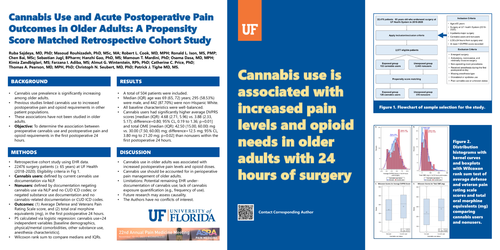
Results: In the full cohort, we identified 800 (3.56%) cannabis users via NLP, of whom only 30 (3.75%) had CUD ICD codes, and 10,798 (48.04%) nonusers. Of those, 2,577 patients (132 cannabis users and 2,455 nonusers) were eligible. Matching yielded a final sample of 504 patients (126 cannabis users and 378 nonusers) (Figure 1). The median (IQR) age was 69 (65, 72) years; 295 (58.53%) were male, and 442 (87.70%) were non-Hispanic White. Baseline characteristics (Table 1) and comorbidities (Table 2) were well-balanced between the groups. Bivariate analysis showed no significant differences in other co-administered analgesic medications. On average, DVPRS scores were assessed at 90-minute intervals, with no baseline differences between groups (Table 3). Cannabis users had significantly higher average DVPRS scores [median (IQR): 4.68 (2.71, 5.96) vs. 3.88 (2.33, 5.17); difference=0.80; 95% confidence limit (CL), 0.19 to 1.36; p=0.01] and total OME [median (IQR): 42.50 (15.00, 60.00) mg vs. 30.00 (7.50, 60.00) mg; difference=12.5 mg; 95% CL, 3.80 mg to 21.20 mg; p=0.02] than nonusers within the first postoperative 24 hours (Figure 2). Cannabis users had significantly higher DVPRS scores than nonusers after adjusting for OME [estimate=1.30; 95% CL, 0.58 to 2.02; p<0.001].
Discussion: This PS-matched retrospective cohort study found that cannabis use was associated with increased acute postoperative pain levels (21%) and opioid requirements (42%) in older adults. These findings are consistent with previous evidence across various patient populations, highlighting needs for tailored pain management strategies. Leveraging NLP techniques to extract cannabis exposure data from EHRs proved vital, enhancing sensitivity compared to relying solely on structured data, and detecting a use prevalence consistent with the older US population (~4%).5 NLP limitations included lacking cannabis exposure quantification and potential underlying cannabis use under-documentation. To mitigate bias and confounding, rigorous methods, including PS matching, were employed. The results support ASRA Pain Medicine’s call for further research on perioperative cannabis use, emphasize the importance of assessing cannabis use preoperatively, and contribute valuable insights to inform precision pain management practices and guidelines in older adults using cannabis.
Disclosure:
The authors have no conflicts of interest, financial, or otherwise.
References:
1. Shah S, Schwenk ES, Sondekoppam RV, et al. ASRA pain medicine consensus guidelines on the management of the perioperative patient on cannabis and cannabinoids. Reg Anesth Pain Med. Published online January 3, 2023. doi:10.1136/rapm-2022-104013
2. Falzone E, Hoffmann C, Keita H. Postoperative Analgesia in Elderly Patients. Drugs Aging. 2013;30(2):81-90. doi:10.1007/s40266-012-0047-7
3. Sajdeya R, Goodin AJ, Tighe PJ. Cannabis use assessment and documentation in healthcare: Priorities for closing the gap. Prev Med. 2021;153:106798. doi:10.1016/j.ypmed.2021.106798
4. Sajdeya R, Mardini MT, Tighe PJ, et al. Developing and validating a natural language processing algorithm to extract preoperative cannabis use status documentation from unstructured narrative clinical notes. J Am Med Inform Assoc JAMIA. Published online May 13, 2023:ocad080. doi:10.1093/jamia/ocad080
5. Substance Abuse and Mental Health Services Administration. Key Substance Use and Mental Health Indicators in the United States: Results from the 2021 National Survey on Drug Use and Health. Center for Behavioral Health Statistics and Quality, Substance Abuse and Mental Health Services Administration; 2022. https://www.samhsa.gov/data/report/2021-nsduh-annual-national-report