Loading...

425 posters, 1 videos, 9 audios, 8 topics, 53 sessions, 340 authors, 286 institutions

ePostersLive by SciGen Technologies S.A. All rights reserved.

22nd Annual Pain Medicine Meeting 2023

November 10 - 11, 2023 | New Orleans Marriott | New Orleans, Louisiana, USA

22nd Annual Pain Medicine Meeting 2023 banner

4652

OPTIMIZATION AND PERSONALIZATION OF SELF-REPORT PAIN INTENSITY ASSESSMENT TOOLS IN PEDIATRIC AND ADOLESCENT POPULATIONS
Part of Topic

Acute Pain

INTRODUCTION

Accurate pain assessment in pediatric populations is indispensable due to the potential adverse consequences associated with untreated pain. Despite the common utilization of self-report tools, children may face difficulties in effectively communicating their pain due to age, cognitive ability, or developmental status. This work evaluated and compared correlation and concordance of commonly used pediatric pain scales such as the Color Analog Scale, Faces Pain Scale-Revised, Numeric Rating Scale, Visual Analog Scale, and Wong-Baker FACES Pain Rating Scale. Furthermore, the level of agreement and utility of electronic delivery of these pain scales was assessed. Overall, this review may enable more personalized pain management in pediatric populations.

METHODS

Objective: Provide an updated literature review comparing pediatric pain assessment tools and assessing the viability of electronic delivery of such tools.

Databases: PubMed/Medline, EMBASE, and Google Scholar.

Inclusion Criteria: Explicit comparisons of 2+ self-report pain scales, English language, human participants between the ages of 3 and 18, published between June 2004 and January 2022.

ØCase reports, editorials, letters, commentaries, overviews, conference abstracts, and reviews or meta-analyses were excluded.
ØReferences of selected articles from database search were also screened via the “Cited by” and “Related Articles” functions offered by Google Scholar.
 
RESULTS
 
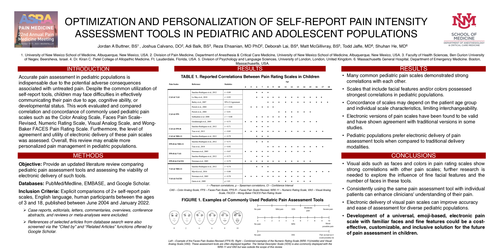
•Many common pediatric pain scales demonstrated strong correlations with each other.
•Scales that include facial features and/or colors possessed strongest correlations in pediatric populations.
•Concordance of scales may depend on the patient age group and individual scale characteristics, limiting interchangeability.
•Electronic versions of pain scales have been found to be valid and have shown agreement with traditional versions in some studies.
•Pediatric populations prefer electronic delivery of pain assessment tools when compared to traditional delivery modalities.
 
CONCLUSIONS
 
•Visual aids such as faces and colors in pain rating scales show strong correlations with other pain scales; further research is needed to explore the influence of fine facial features and the number of faces in these tools.
•Consistently using the same pain assessment tool with individual patients can enhance clinicians' understanding of their pain.
•Electronic delivery of visual pain scales can improve accuracy and ease of assessment for diverse pediatric populations.
•Development of a universal, emoji-based, electronic pain scale with familiar faces and fine features could be a cost-effective, customizable, and inclusive solution for the future of pain assessment in children.
22nd Annual Pain Medicine Meeting 2023 » banner
Copyright © 2015-2026, ePostersLive® SciGen is a registered trademark of SciGen Technologies S.A. Patent pending.

This website and third-party tools we use rely on cookies for the best user experience. By selecting "I agree", you agree to cookie usage as described in our Privacy Policy.