126 posters, 2 topics, 27 sessions, 324 authors, 82 institutions
ePostersLive by SciGen Technologies S.A. All rights reserved.
2025 ACP Annual Session
October 22 - 25, 2025 | New Orleans, US

73
Self-Developed AI-Assisted Smartphone-Based Photogrammetry for Implant-Supported Complete-Arch Fixed Dental Prostheses (ISCFDPs)
Poster Presenter
Part of Topic
Case Presentation
Self-Developed AI-Assisted Smartphone-Based Photogrammetry for Implant-Supported Complete-Arch Fixed Dental Prostheses (ISCFDPs)
Objectives
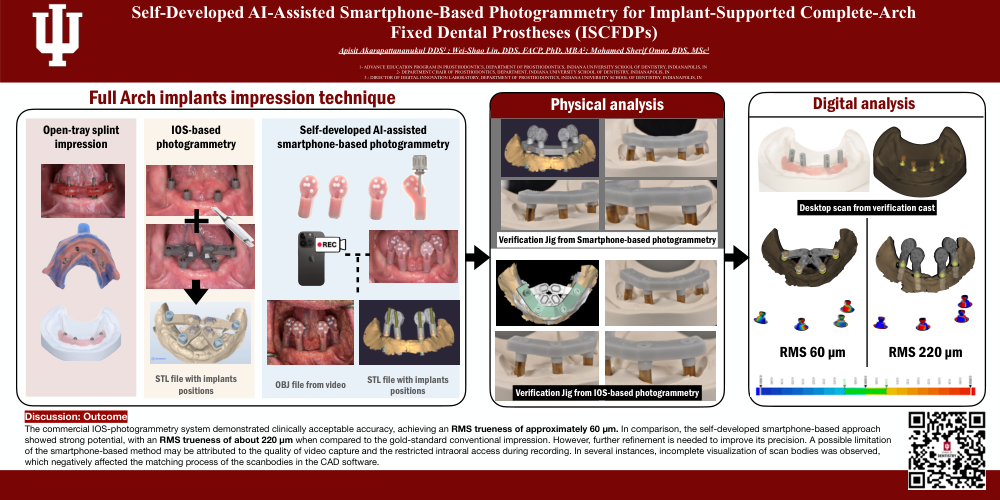
Achieving a passive fit is critical for the long-term success of ISCFDPs, and it begins with an accurate impression. While the open-tray splinted technique remains the gold standard, it is time-consuming. The use of intraoral scanners (IOS) for ISCFDPs is still debated due to accuracy concerns. Emerging technologies such as photogrammetry and artificial intelligence (AI) offer promising alternatives. Although commercial photogrammetry systems show potential, they are not yet widely accessible. This report aimed to create a self-developed AI-assisted smartphone-based photogrammetry program using open-source tools and customized scanbodies to generate 3D models from 2D video frames.
Case History / Technical Steps
A 68-year-old patient with four mandibular implants and an interim ISCFDP was treated using three impression techniques: (1) open-tray splinted impression (producing reference, a verified cast), (2) commercial IOS-based photogrammetry system (IO Connect; TruAbutment Inc), and (3) self-developed AI-assisted smartphone-based photogrammetry system and customized scanbodies. Verification devices were fabricated from techniques #2 and #3 and assessed on the reference cast using tactile and digital analysis.
Discussion: Outcome / Follow-Up
The commercial IOS-photogrammetry system produced clinically acceptable results. The self-developed smartphone-based approach demonstrated strong potential but requires further refinement. One possible limitation may be related to the quality of smartphone video capture and restricted intraoral access during videography, which negatively affected the matching process of the scanbodies in the CAD software. These factors could have influenced the 3D reconstruction accuracy.
Conclusions
With continued development, the AI-assisted smartphone photogrammetry system may offer a practical and cost-effective alternative to commercial systems in full-arch implant workflows.