126 posters, 2 topics, 27 sessions, 324 authors, 82 institutions
ePostersLive by SciGen Technologies S.A. All rights reserved.
2025 ACP Annual Session
October 22 - 25, 2025 | New Orleans, US

48
Managing Ectodermal Dysplasia with Digital Precision: Long-Term Provisionalization Using 3D-Printed Nano-Ceramic Hybrid Resin
Poster Presenter
Authors
Affiliations
Part of Topic
Case Presentation
Managing Ectodermal Dysplasia with Digital Precision: Long-Term Provisionalization Using 3D-Printed Nano-Ceramic Hybrid Resin.
Ashraf Kheder, DDS; Ahmed Gabir DDT, BDS, MPH; Charles Beard, DDS, MS; Berna Saglik DDS, MS, FACP
Department of Biologic and Materials Sciences & Prosthodontics, University of Michigan School of Dentistry .
Introduction:
Ectodermal dysplasia (ED) commonly presents with congenitally missing teeth, conical dentition, and underdeveloped alveolar ridges, producing esthetic, functional, and psychosocial challenges (Itthagarun & King 1997; Pigno et al. 1996). In adolescents, prosthodontic management is complicated by ongoing craniofacial growth, often necessitating long-term interim care until skeletal maturity (McDonald & Avery 2016). Digital workflows enable precise planning, design, and fabrication of interim restorations with reproducibility and reduced chairside time (Miyazaki et al. 2009). Additive manufacturing of resin-matrix ceramics (RMCs) provides improved esthetics, mechanical behavior, and repairability compared with conventional PMMA-based interim restorations (Awada & Nathanson 2015).
Objectives:
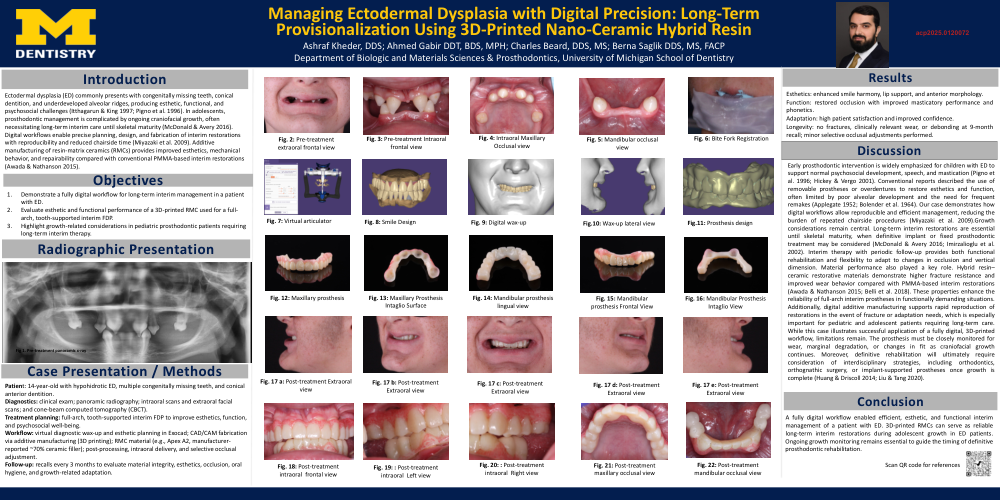
Patient: 14-year-old with hypohidrotic ED, multiple congenitally missing teeth, and conical anterior dentition.
Diagnostics: clinical exam; panoramic radiography; intraoral scans and extraoral facial scans; and cone-beam computed tomography (CBCT).
Treatment planning: full-arch, tooth-supported interim FDP to improve esthetics, function, and psychosocial well-being.
Workflow: virtual diagnostic wax-up and esthetic planning in Exocad; CAD/CAM fabrication via additive manufacturing (3D printing); RMC material (e.g., Apex A2, manufacturer-reported ~70% ceramic filler); post-processing, intraoral delivery, and selective occlusal adjustment.
Follow-up: recalls every 3 months to evaluate material integrity, esthetics, occlusion, oral hygiene, and growth-related adaptation.
Results:
Esthetics: enhanced smile harmony, lip support, and anterior morphology.
Function: restored occlusion with improved masticatory performance and phonetics.
Adaptation: high patient satisfaction and improved confidence.
Longevity: no fractures, clinically relevant wear, or debonding at 9-month recall; minor selective occlusal adjustments performed.
Discussion:
Early prosthodontic intervention is widely emphasized for children with ED to support normal psychosocial development, speech, and mastication (Pigno et al. 1996; Hickey & Vergo 2001). Conventional reports described the use of removable prostheses or overdentures to restore esthetics and function, often limited by poor alveolar development and the need for frequent remakes (Applegate 1952; Bolender et al. 1964). Our case demonstrates how digital workflows allow reproducible and efficient management, reducing the burden of repeated chairside procedures (Miyazaki et al. 2009).Growth considerations remain central. Long-term interim restorations are essential until skeletal maturity, when definitive implant or fixed prosthodontic treatment may be considered (McDonald & Avery 2016; Imirzalioglu et al. 2002). Interim therapy with periodic follow-up provides both functional rehabilitation and flexibility to adapt to changes in occlusion and vertical dimension. Material performance also played a key role. Hybrid resin–ceramic restorative materials demonstrate higher fracture resistance and improved wear behavior compared with PMMA-based interim restorations (Awada & Nathanson 2015; Belli et al. 2018). These properties enhance the reliability of full-arch interim prostheses in functionally demanding situations. Additionally, digital additive manufacturing supports rapid reproduction of restorations in the event of fracture or adaptation needs, which is especially important for pediatric and adolescent patients requiring long-term care. While this case illustrates successful application of a fully digital, 3D-printed workflow, limitations remain. The prosthesis must be closely monitored for wear, marginal degradation, or changes in fit as craniofacial growth continues. Moreover, definitive rehabilitation will ultimately require consideration of interdisciplinary strategies, including orthodontics, orthognathic surgery, or implant-supported prostheses once growth is complete (Huang & Driscoll 2014; Liu & Tang 2020).
Conclusion:
A fully digital workflow enabled efficient, esthetic, and functional interim management of a patient with ED. 3D-printed RMCs can serve as reliable long-term interim restorations during adolescent growth in ED patients. Ongoing growth monitoring remains essential to guide the timing of definitive prosthodontic rehabilitation.