126 posters, 2 topics, 27 sessions, 324 authors, 82 institutions
ePostersLive by SciGen Technologies S.A. All rights reserved.
2025 ACP Annual Session
October 22 - 25, 2025 | New Orleans, US

29
Optimizing Multiple-Unit Maxillary Fixed Prosthodontic Provisionalization
Poster Presenter
Authors
Apissada (May) Jindarojanakul, Wissanee Jia-Mahasap, Jason Lee
Affiliations
Part of Topic
Case Presentation
Optimizing Provisionalization for Multiple-Unit Maxillary Fixed Prostheses
Apissada Jindarojanakul, DDS* , Wissanee Jia-Mahasap, DDS, MS, FACP, Jason Lee, DDS, MMSc, FACP
Advanced Graduate Program in Prosthodontics, Harvard School of Dental Medicine, Boston, MA | *presenter
Introduction
The indirect-direct technique1 or shell overlay technique2 is a common method for provisional restoration fabrication for complex multiple-unit fixed prostheses3. However, seating of the shell is susceptible to errors, including increased vertical dimension, inaccurate wax-up replication, and misalignment, often resulting from improper seating of the provisional restoration during chairside relining or from acrylic processing inaccuracies 2,4.
To address this issue, this case presentation introduces a digital approach for fabricating provisional restorations with an integrated seating component using CAD and additive manufacturing technology5,6, which aims to reduce errors and enhance precision.
Objectives
- To propose innovative design concept for a maxillary arch provisional shell
- To achieve accurate vertical dimension, precise wax-up reproduction, and minimal chair-side adjustments following relining through the proposed design
- To describe each element of the design and provide the rationale behind its inclusion
Clinical Significance
This proposed design for maxillary arch provisionalization provides reliable control of vertical dimension, precise transfer of the diagnostic wax-up, and reduces the need for extensive chair-side adjustments during relining.
Case Scenario
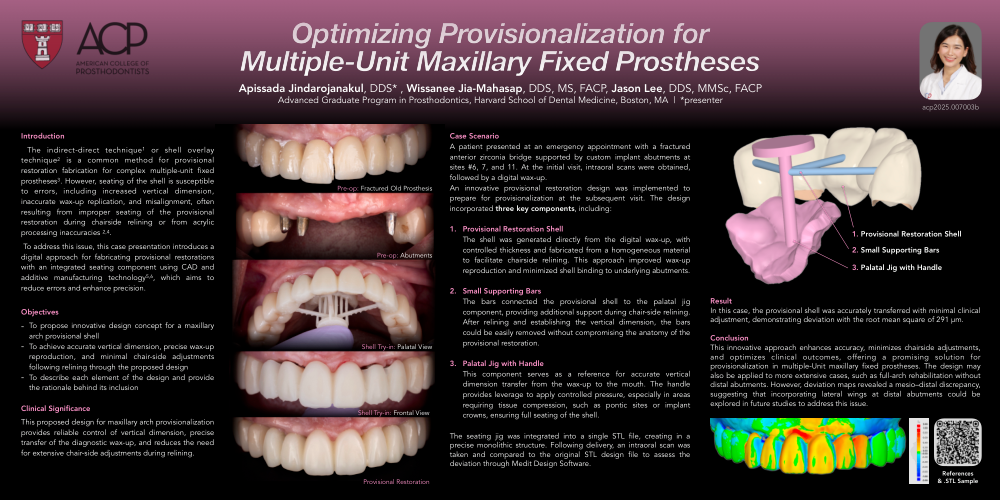
A patient presented at an emergency appointment with a fractured anterior zirconia bridge supported by custom implant abutments at sites #6, 7, and 11. At the initial visit, intraoral scans were obtained, followed by a digital wax-up.
An innovative provisional restoration design was implemented to prepare for provisionalization at the subsequent visit. The design incorporated three key components, including:
- Provisional Restoration Shell
The shell was generated directly from the digital wax-up, with controlled thickness and fabricated from a homogeneous material to facilitate chairside relining. This approach improved wax-up reproduction and minimized shell binding to underlying abutments. - Small Supporting Bars
The bars connected the provisional shell to the palatal jig component, providing additional support during chair-side relining. After relining and establishing the vertical dimension, the bars could be easily removed without compromising the anatomy of the provisional restoration. - Palatal Jig with Handle
This component serves as a reference for accurate vertical dimension transfer from the wax-up to the mouth. The handle provides leverage to apply controlled pressure, especially in areas requiring tissue compression, such as pontic sites or implant crowns, ensuring full seating of the shell.
The seating jig was integrated into a single STL file, creating in a precise monolithic structure. Following delivery, an intraoral scan was taken and compared to the original STL design file to assess the deviation through Medit Design Software.
Result
In this case, the provisional shell was accurately transferred with minimal clinical adjustment, demonstrating deviation with the root mean square of 291 µm.
Conclusion
This innovative approach enhances accuracy, minimizes chairside adjustments, and optimizes clinical outcomes, offering a promising solution for provisionalization in multiple-Unit maxillary fixed prostheses. The design may also be applied to more extensive cases, such as full-arch rehabilitation without distal abutments. However, deviation maps revealed a mesio–distal discrepancy, suggesting that incorporating lateral wings at distal abutments could be explored in future studies to address this issue.