126 posters, 2 topics, 27 sessions, 324 authors, 82 institutions
ePostersLive by SciGen Technologies S.A. All rights reserved.
2025 ACP Annual Session
October 22 - 25, 2025 | New Orleans, US

28
Combined tooth-bone supported static computer-assisted implant surgical guide for free-end surgical implant placement
Poster Presenter
Authors
Affiliations
Part of Topic
Case Presentation
Case Report: Combined tooth-bone supported static computer-assisted implant surgical guide for free-end surgical implant placement
Herschel Ungar DDS , Berna Saglik DDS, MS
Department of Biologic and Materials Sciences & Prosthodontics , University of Michigan School of Dentistry
BACKGROUND
The prosthetically-driven approach to dental implant surgery prioritizes the final restorative outcome, ensuring that implant placement aligns with optimal esthetic, functional, and biomechanical requirements. Guided implant surgery plays a critical role in executing this approach by providing a template for accurate implant placement, minimizing deviations in angulation, depth, and position. Computer-aided implant surgery has proven particularly reliable for single-tooth restorations, where tooth-supported guides offer stable and predictable outcomes. However, challenges arise in free-end situations, such as distal extension edentulous spans, where guided accuracy is lower compared to tooth-borne cases.
OBJECTIVES
This case study evaluates the design, fabrication, and surgical application of a combined tooth-bone supported static computer assisted implant surgery (sCAIS) for use in a free-end edentulous site, focusing on its effectiveness in achieving the prosthetically-driven implant.
CASE PRESENTATION & TECHNICAL STEPS
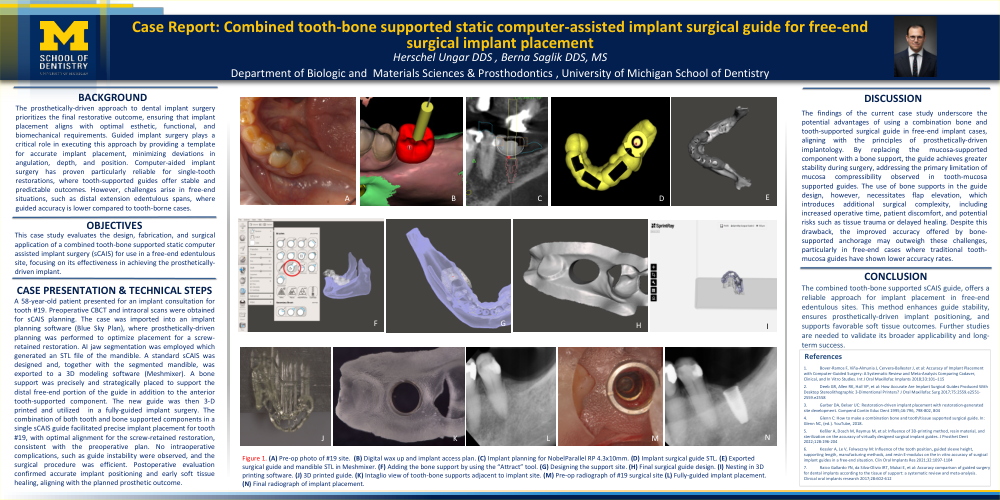
A 58-year-old patient presented for an implant consultation for tooth #19. Preoperative CBCT and intraoral scans were obtained for sCAIS planning. The case was imported into an implant planning software (Blue Sky Plan), where prosthetically-driven planning was performed to optimize placement for a screw-retained restoration. AI jaw segmentation was employed which generated an STL file of the mandible. A standard sCAIS was designed and, together with the segmented mandible, was exported to a 3D modeling software (Meshmixer). A bone support was precisely and strategically placed to support the distal free-end portion of the guide in addition to the anterior tooth-supported component. The new guide was then 3-D printed and utilized in a fully-guided implant surgery. The combination of both tooth and bone supported components in a single sCAIS guide facilitated precise implant placement for tooth #19, with optimal alignment for the screw-retained restoration, consistent with the preoperative plan. No intraoperative complications, such as guide instability were observed, and the surgical procedure was efficient. Postoperative evaluation confirmed accurate implant positioning and early soft tissue healing, aligning with the planned prosthetic outcome.
DISCUSSION
The findings of the current case study underscore the potential advantages of using a combination bone and tooth-supported surgical guide in free-end implant cases, aligning with the principles of prosthetically-driven implantology. By replacing the mucosa-supported component with a bone support, the guide achieves greater stability during surgery, addressing the primary limitation of mucosa compressibility observed in tooth-mucosa supported guides. The use of bone supports in the guide design, however, necessitates flap elevation, which introduces additional surgical complexity, including increased operative time, patient discomfort, and potential risks such as tissue trauma or delayed healing. Despite this drawback, the improved accuracy offered by bone-supported anchorage may outweigh these challenges, particularly in free-end cases where traditional tooth-mucosa guides have shown lower accuracy rates.
CONCLUSION
The combined tooth-bone supported sCAIS guide, offers a reliable approach for implant placement in free-end edentulous sites. This method enhances guide stability, ensures prosthetically-driven implant positioning, and supports favorable soft tissue outcomes. Further studies are needed to validate its broader applicability and long-term success.
References
1. Bover-Ramos F, Viña-Almunia J, Cervera-Ballester J, et al: Accuracy of Implant Placement with Computer-Guided Surgery: A Systematic Review and Meta-Analysis Comparing Cadaver, Clinical, and In Vitro Studies. Int J Oral Maxillofac Implants 2018;33:101–115
2. Deeb GR, Allen RK, Hall VP, et al: How Accurate Are Implant Surgical Guides Produced With Desktop Stereolithographic 3-Dimentional Printers? J Oral Maxillofac Surg 2017;75:2559.e2551-2559.e2558
3. Garber DA, Belser UC: Restoration-driven implant placement with restoration-generated site development. Compend Contin Educ Dent 1995;16:796, 798-802, 804
4. Glenn C: How to make a combination bone and tooth/tissue supported surgical guide. In: Glenn NC, (ed.). YouTube, 2018.
5. Keßler A, Dosch M, Reymus M, et al: Influence of 3D-printing method, resin material, and sterilization on the accuracy of virtually designed surgical implant guides. J Prosthet Dent 2022;128:196-204
6. Kessler A, Le V, Folwaczny M: Influence of the tooth position, guided sleeve height, supporting length, manufacturing methods, and resin E-modulus on the in vitro accuracy of surgical implant guides in a free-end situation. Clin Oral Implants Res 2021;32:1097-1104
7. Raico Gallardo YN, da Silva‐Olivio IRT, Mukai E, et al: Accuracy comparison of guided surgery for dental implants according to the tissue of support: a systematic review and meta‐analysis. Clinical oral implants research 2017;28:602-612