126 posters, 2 topics, 27 sessions, 324 authors, 82 institutions
ePostersLive by SciGen Technologies S.A. All rights reserved.
2025 ACP Annual Session
October 22 - 25, 2025 | New Orleans, US

208
Prosthodontic Treatment for a 6-Year-Old with Ectodermal Dysplasia: A Case Report
Poster Presenter
Part of Topic
Case Presentation
Prosthodontic Treatment for a 6-Year-Old with Ectodermal Dysplasia: A Case Report
Girnary, M.S., Vickers, V.A., Haney, S.J., Cobb Jr., G.W., Zhang, H.
Department of Comprehensive Dentistry, University of Texas Health Science Center at San Antonio
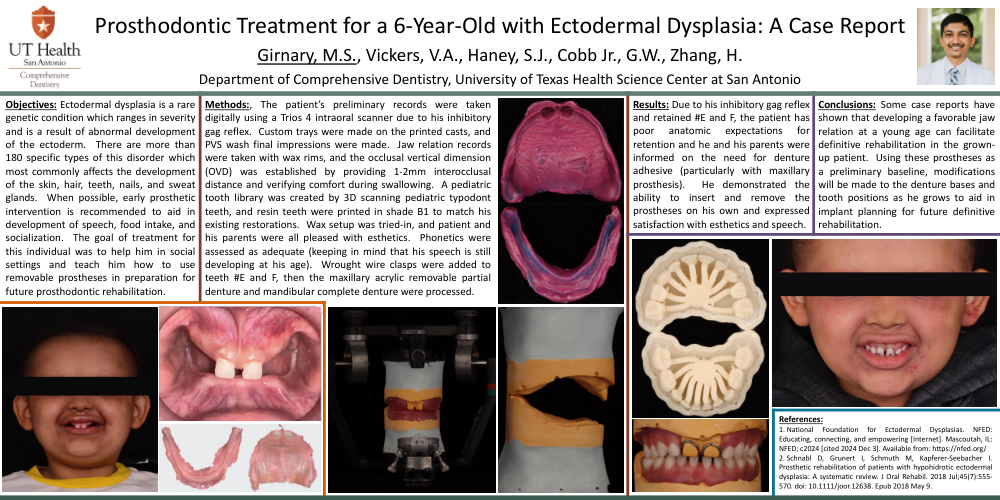
Objectives: Ectodermal dysplasia is a rare genetic condition caused by abnormal ectodermal development, with over 180 types identified. It most often affects skin, hair, teeth, nails, and sweat glands. Early prosthetic intervention can aid speech, mastication, and socialization. This case aimed to help a young patient function in social settings and adapt to removable prostheses in preparation for future prosthodontic rehabilitation.
Methods: Due to the patient’s strong gag reflex, preliminary records were obtained digitally using a Trios 4 intraoral scanner. Custom trays were fabricated on 3D printed casts, and PVS final impressions were made. Jaw relation records were taken with wax rims, establishing occlusal vertical dimension (OVD) with 1–2 mm interocclusal distance and verifying comfort during swallowing. A custom pediatric tooth library was created by scanning typodont teeth, and resin teeth were printed in shade B1 to match existing restorations. The wax try-in was approved by the patient and parents, and phonetics were acceptable given ongoing speech development. Wrought wire clasps were added to teeth #E and F, and a maxillary acrylic removable partial denture and mandibular complete denture were conventionally processed.
Results: Retention was limited due to his gag reflex and retained #E and F, and the need for denture adhesive, particularly for the maxillary prosthesis, was explained. The patient demonstrated insertion and removal of prostheses and expressed satisfaction with esthetics and speech.
Conclusions: Early establishment of a favorable maxillomandibular relationship can aid definitive rehabilitation later. These prostheses can be modified over time to accommodate growth and guide implant planning for future treatment.