126 posters, 2 topics, 27 sessions, 324 authors, 82 institutions
ePostersLive by SciGen Technologies S.A. All rights reserved.
2025 ACP Annual Session
October 22 - 25, 2025 | New Orleans, US

192
Hybrid Analogue–Digital Workflow Utilizing a Processed Base for Jaw Relations in Maxillary Hybrid Prosthesis and Mandibular Locator Overdenture Fabrication
Poster Presenter
Authors
Affiliations
Part of Topic
Case Presentation
Hybrid Analogue–Digital Workflow Utilizing a Processed Base for Jaw Relations in Maxillary Hybrid Prosthesis and Mandibular Locator Overdenture Fabrication
Patrick Gardullo, DDS
Department of Prosthodontics, Eastman Institute for Oral Health, University of Rochester
Objectives
To describe a hybrid analogue–digital workflow that incorporates a processed record base for jaw relation records and prosthesis fabrication in the rehabilitation of a maxillary implant-supported hybrid prosthesis and a mandibular locator-retained overdenture. This case demonstrates how combining conventional record base accuracy with digital tooth design and modern denture base materials can improve outcomes in complex implant prosthodontics.
Patient Presentation
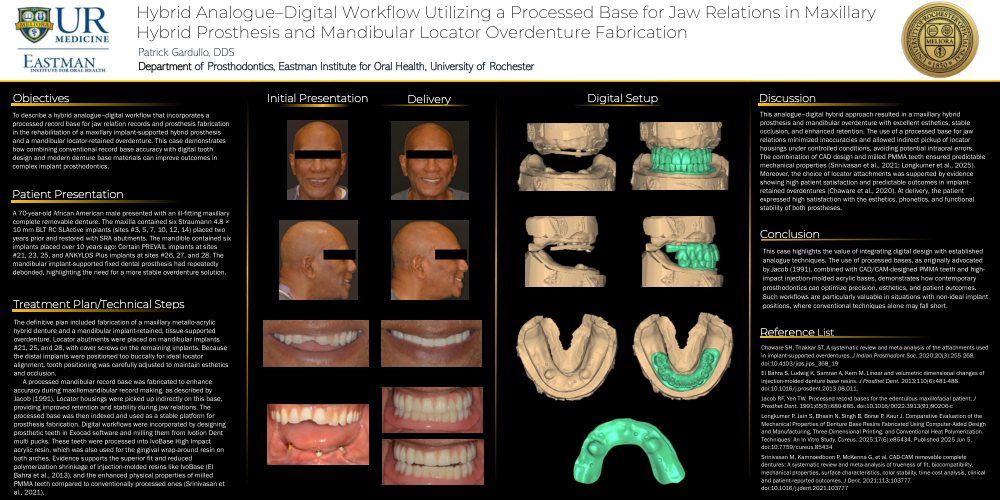
A 70-year-old African American male presented with an ill-fitting maxillary complete removable denture. The maxilla contained six Straumann 4.8 × 10 mm BLT RC SLActive implants (sites #3, 5, 7, 10, 12, 14) placed two years prior and restored with SRA abutments. The mandible contained six implants placed over 10 years ago: Certain PREVAIL implants at sites #21, 23, 25, and ANKYLOS Plus implants at sites #26, 27, and 28. The mandibular implant-supported fixed dental prosthesis had repeatedly debonded, highlighting the need for a more stable overdenture solution.
Treatment Plan/Technical Steps
The definitive plan included fabrication of a maxillary metallo-acrylic hybrid denture and a mandibular implant-retained, tissue-supported overdenture. Locator abutments were placed on mandibular implants #21, 25, and 28, with cover screws on the remaining implants. Because the distal implants were positioned too buccally for ideal locator alignment, tooth positioning was carefully adjusted to maintain esthetics and occlusion.
A processed mandibular record base was fabricated to enhance accuracy during maxillomandibular record making, as described by Jacob (1991). Locator housings were picked up indirectly on this base, providing improved retention and stability during jaw relations. The processed base was then indexed and used as a stable platform for prosthesis fabrication. Digital workflows were incorporated by designing prosthetic teeth in Exocad software and milling them from Ivotion Dent multi pucks. These teeth were processed into IvoBase High Impact acrylic resin, which was also used for the gingival wrap-around resin on both arches. Evidence supports the superior fit and reduced polymerization shrinkage of injection-molded resins like IvoBase (El Bahra et al., 2013), and the enhanced physical properties of milled PMMA teeth compared to conventionally processed ones (Srinivasan et al., 2021).
Discussion
This analogue–digital hybrid approach resulted in a maxillary hybrid prosthesis and mandibular overdenture with excellent esthetics, stable occlusion, and enhanced retention. The use of a processed base for jaw relations minimized inaccuracies and allowed indirect pickup of locator housings under controlled conditions, avoiding potential intraoral errors. The combination of CAD design and milled PMMA teeth ensured predictable mechanical properties (Srinivasan et al., 2021; Longkumer et al., 2025). Moreover, the choice of locator attachments was supported by evidence showing high patient satisfaction and predictable outcomes in implant-retained overdentures (Chaware et al., 2020). At delivery, the patient expressed high satisfaction with the esthetics, phonetics, and functional stability of both prostheses.
Conclusion
This case highlights the value of integrating digital design with established analogue techniques. The use of processed bases, as originally advocated by Jacob (1991), combined with CAD/CAM-designed PMMA teeth and high-impact injection-molded acrylic bases, demonstrates how contemporary prosthodontics can optimize precision, esthetics, and patient outcomes. Such workflows are particularly valuable in situations with non-ideal implant positions, where conventional techniques alone may fall short.
Reference List
Chaware SH, Thakkar ST. A systematic review and meta-analysis of the attachments used in implant-supported overdentures. J Indian Prosthodont Soc. 2020;20(3):255-268. doi:10.4103/jips.jips_368_19
El Bahra S, Ludwig K, Samran A, Kern M. Linear and volumetric dimensional changes of injection-molded denture base resins. J Prosthet Dent. 2013;110(6):481-488. doi:10.1016/j.prosdent.2013.08.011.
Jacob RF, Yen TW. Processed record bases for the edentulous maxillofacial patient. J Prosthet Dent. 1991;65(5):680-685. doi:10.1016/0022-3913(91)90206-c
Longkumer P, Jain S, Bhasin N, Singh B, Borse P, Kaur J. Comparative Evaluation of the Mechanical Properties of Denture Base Resins Fabricated Using Computer-Aided Design and Manufacturing, Three-Dimensional Printing, and Conventional Heat Polymerization Techniques: An In Vitro Study. Cureus. 2025;17(6):e85434. Published 2025 Jun 5. doi:10.7759/cureus.85434
Srinivasan M, Kamnoedboon P, McKenna G, et al. CAD-CAM removable complete dentures: A systematic review and meta-analysis of trueness of fit, biocompatibility, mechanical properties, surface characteristics, color stability, time-cost analysis, clinical and patient-reported outcomes. J Dent. 2021;113:103777. doi:10.1016/j.jdent.2021.103777