126 posters, 2 topics, 27 sessions, 324 authors, 82 institutions
ePostersLive by SciGen Technologies S.A. All rights reserved.
2025 ACP Annual Session
October 22 - 25, 2025 | New Orleans, US

175
Artificial Intelligence in Prosthodontics: Enhancing Patient Care Across the Digital Workflow
Poster Presenter
Authors
Affiliations
Part of Topic
Case Presentation
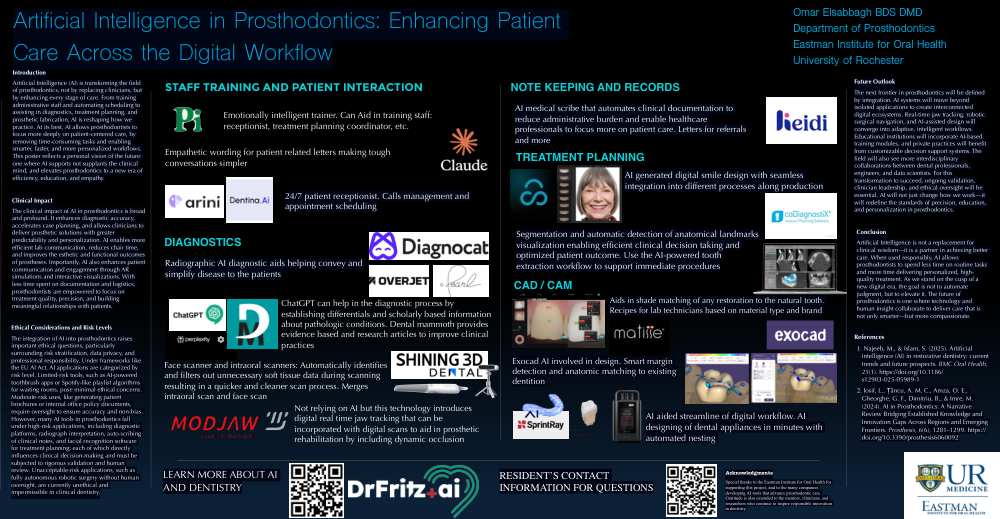
Introduction Artificial Intelligence (AI) is transforming the field of prosthodontics, not by replacing clinicians, but by enhancing every stage of care. From training administrative staff and automating scheduling to assisting in diagnostics, treatment planning, and prosthetic fabrication, AI is reshaping how we practice. At its best, AI allows prosthodontists to focus more deeply on patient-centered care, by removing time-consuming tasks and enabling smarter, faster, and more personalized workflows. This poster reflects a personal vision of the future: one where AI supports not supplants the clinical mind, and elevates prosthodontics to a new era of efficiency, education, and empathy. AI generated digital smile design with seamless integration into different processes along production Clinical Impact The clinical impact of AI in prosthodontics is broad and profound. It enhances diagnostic accuracy, accelerates case planning, and allows clinicians to deliver prosthetic solutions with greater predictability and personalization. AI enables more efficient lab communication, reduces chair time, and improves the esthetic and functional outcomes of prostheses. Importantly, AI also enhances patient communication and engagement through AR simulations and interactive visualizations. With less time spent on documentation and logistics, prosthodontists are empowered to focus on treatment quality, precision, and building meaningful relationships with patients. Future Outlook The next frontier in prosthodontics will be defined by integration. AI systems will move beyond isolated applications to create interconnected digital ecosystems. Real-time jaw tracking, robotic surgical navigation, and AI-assisted design will converge into adaptive, intelligent workflows. Educational institutions will incorporate AI-based training modules, and private practices will benefit from customizable decision support systems. The field will also see more interdisciplinary collaborations between dental professionals, engineers, and data scientists. For this transformation to succeed, ongoing validation, clinician leadership, and ethical oversight will be essential. AI will not just change how we work—it will redefine the standards of precision, education, and personalization in prosthodontics. Omar Elsabbagh BDS DMD Department of Prosthodontics Eastman Institute for Oral Health University of Rochester Artificial Intelligence in Prosthodontics: Enhancing Patient Care Across the Digital Workflow STAFF TRAINING AND PATIENT INTERACTION Exocad AI involved in design. Smart margin detection and anatomic matching to existing dentition Aids in shade matching of any restoration to the natural tooth. Recipes for lab technicians based on material type and brand AI aided streamline of digital workflow. AI designing of dental appliances in minutes with automated nesting Face scanner and intraoral scanners: Automatically identifies and filters out unnecessary soft tissue data during scanning resulting in a quicker and cleaner scan process. Merges intraoral scan and face scan Emotionally intelligent trainer. Can Aid in training staff: receptionist, treatment planning coordinator, etc. Conclusion Artificial Intelligence is not a replacement for clinical wisdom—it is a partner in achieving better care. When used responsibly, AI allows prosthodontists to spend less time on routine tasks and more time delivering personalized, high-quality treatment. As we stand on the cusp of a new digital era, the goal is not to automate judgment, but to elevate it. The future of prosthodontics is one where technology and human insight collaborate to deliver care that is not only smarter—but more compassionate. Acknowledgments Special thanks to the Eastman Institute for Oral Health for supporting this project, and to the many companies developing AI tools that advance prosthodontic care. Gratitude is also extended to the mentors, clinicians, and researchers who continue to inspire responsible innovation in dentistry. References 1. Najeeb, M., & Islam, S. (2025). Artificial intelligence (AI) in restorative dentistry: current trends and future prospects. BMC Oral Health, 25(1). https://doi.org/10.1186/ s12903-025-05989-1 2. Iosif, L., Țâncu, A. M. C., Amza, O. E., Gheorghe, G. F., Dimitriu, B., & Imre, M. (2024). AI in Prosthodontics: A Narrative Review Bridging Established Knowledge and Innovation Gaps Across Regions and Emerging Frontiers. Prosthesis, 6(6), 1281–1299. https:// doi.org/10.3390/prosthesis6060092 AI medical scribe that automates clinical documentation to reduce administrative burden and enable healthcare professionals to focus more on patient care. Letters for referrals and more 24/7 patient receptionist. Calls management and appointment scheduling Radiographic AI diagnostic aids helping convey and simplify disease to the patients Segmentation and automatic detection of anatomical landmarks visualization enabling efficient clinical decision taking and optimized patient outcome. Use the AI-powered tooth extraction workflow to support immediate procedures Ethical Considerations and Risk Levels The integration of AI into prosthodontics raises important ethical questions, particularly surrounding risk stratification, data privacy, and professional responsibility. Under frameworks like the EU AI Act, AI applications are categorized by risk level. Limited-risk tools, such as AI-powered toothbrush apps or Spotify-like playlist algorithms for waiting rooms, pose minimal ethical concerns. Moderate-risk uses, like generating patient brochures or internal office policy documents, require oversight to ensure accuracy and non-bias. However, many AI tools in prosthodontics fall under high-risk applications, including diagnostic platforms, radiograph interpretation, auto-scribing of clinical notes, and facial recognition software for treatment planning; each of which directly influences clinical decision-making and must be subjected to rigorous validation and human review. Unacceptable-risk applications, such as fully autonomous robotic surgery without human oversight, are currently unethical and impermissible in clinical dentistry. ChatGPT can help in the diagnostic process by establishing differentials and scholarly based information about pathologic conditions. Dental mammoth provides evidence based and research articles to improve clinical practices Empathetic wording for patient related letters making tough conversations simpler DIAGNOSTICS NOTE KEEPING AND RECORDS TREATMENT PLANNING CAD / CAM LEARN MORE ABOUT AI AND DENTISTRY Not relying on AI but this technology introduces digital real time jaw tracking that can be incorporated with digital scans to aid in prosthetic rehabilitation by including dynamic occlusion RESIDENT’S CONTACT INFORMATION FOR QUESTIONS