126 posters, 2 topics, 27 sessions, 324 authors, 82 institutions
ePostersLive by SciGen Technologies S.A. All rights reserved.
2025 ACP Annual Session
October 22 - 25, 2025 | New Orleans, US

168
Prosthetically Driven Full-Arch Rehabilitation of an Edentulous Patient Using a Combined FP1–FP3 Approach: A Two-Stage Surgical Protocol.
Poster Presenter
Authors
Affiliations
Part of Topic
Case Presentation
Introduction
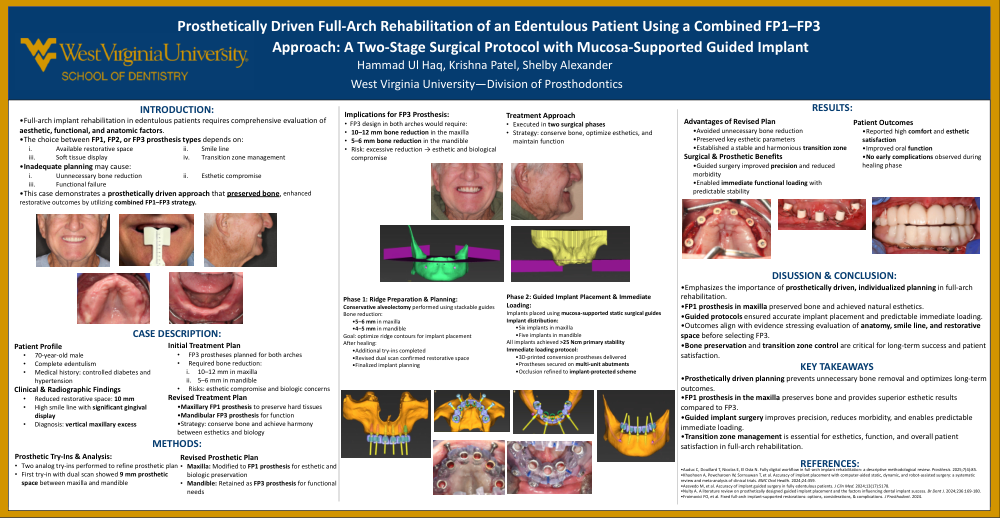
Full-arch implant rehabilitation in edentulous patients requires comprehensive evaluation of esthetic, functional, and anatomic factors. The decision between FP1, FP2, or FP3 prosthesis types is influenced by restorative space, smile line, soft tissue display, and transition zone management. Inadequate planning can result in unnecessary bone reduction, esthetic compromise, and functional failure. This case highlights a prosthetically driven approach that preserved bone and improved restorative outcomes through a combined FP1–FP3 strategy.
Case Description
A 70-year-old male with complete edentulism, controlled diabetes, and hypertension presented for fixed implant prostheses in both arches. Clinical and radiographic analysis revealed reduced restorative space of 10 mm and a high smile line with significant gingival display due to vertical maxillary excess. Initial planning for FP3 prostheses in both arches required 15 mm bone reduction in the maxilla and 10 mm in the mandible, which risked esthetic and biologic compromise. To preserve bone and harmonize esthetics, the plan was revised to a maxillary FP1 and mandibular FP3 prosthesis.
Methods
The patient underwent three analog try-ins to refine the prosthetic plan. The first try-in and dual scan revealed that only 9 mm of prosthetic space existed between the maxilla and mandible. For an FP3 design in both arches, this would have required 10–12 mm of bone reduction in the maxilla and approximately 5–6 mm in the mandible.
To preserve esthetics and avoid excessive reduction, the maxillary plan was modified to an FP1 prosthesis for biological and esthetic reasons, while the mandible was maintained as an FP3. Treatment proceeded in two surgical phases:
-
Phase 1: Conservative alveolectomy was carried out, with 5–6 mm of bone reduced in the maxilla and 4–5 mm in the mandible to optimize ridge contours for implant placement. Following healing, further try-ins and a revised dual scan were performed to confirm restorative space and finalize implant planning.
-
Phase 2: Guided implant placement was executed using mucosa-supported static surgical guides. A total of six implants in the maxilla and five in the mandible were placed, all achieving >25 Ncm primary stability. Immediate loading was completed using 3D-printed conversion prostheses secured on multi-unit abutments, and occlusion was refined to an implant-protected scheme.
_________________________________________________________________________________________________________________________
Results
The revised plan avoided unnecessary bone reduction, preserved esthetic parameters, and provided a stable transition zone. Guided surgery enhanced surgical precision, reduced morbidity, and allowed immediate functional loading with predictable stability. The patient reported comfort, esthetic satisfaction, and functional improvement, with no early complications observed during healing.
Discussion & Conclusion
This case emphasizes the importance of prosthetically driven, individualized planning in full-arch rehabilitation. Selecting an FP1 prosthesis for the maxilla avoided irreversible bone loss while achieving a natural esthetic outcome. Guided protocols facilitated accurate implant placement and predictable immediate loading. These outcomes align with current evidence underscoring the need to evaluate anatomy, smile line, and restorative space before committing to an FP3 approach. Bone preservation and transition zone control remain essential for long-term success and patient satisfaction.
Key Takeaways
-
Prosthetically driven planning prevents unnecessary bone removal and optimizes long-term outcomes.
-
FP1 prostheses in the maxilla can preserve bone and improve esthetic results compared to FP3.
-
Guided implant surgery enhances precision, reduces morbidity, and supports predictable immediate loading.
-
Transition zone management is critical for patient satisfaction in full-arch implant rehabilitation.