126 posters, 2 topics, 27 sessions, 324 authors, 82 institutions
ePostersLive by SciGen Technologies S.A. All rights reserved.
2025 ACP Annual Session
October 22 - 25, 2025 | New Orleans, US

136
Beyond the Ridge: The Zygomatic Implant Workflow from Surgical Precision to Prosthetic Perfection
Poster Presenter
Part of Topic
Case Presentation
Beyond the Ridge: The Zygomatic Implant Workflow from Surgical Precision to Prosthetic Perfection
Hui Ling Cheah BDS MSc, Shalom Benzaquen DMD MS, Kyle Mecca DMD MBA MS, Brian Brodine DDS MDS FACP, Konstantinos Chochlidakis DDS MS FACP, Carlo Ercoli DDS MBA FACP
Eastman Institute for Oral Health, University of Rochester, NY.
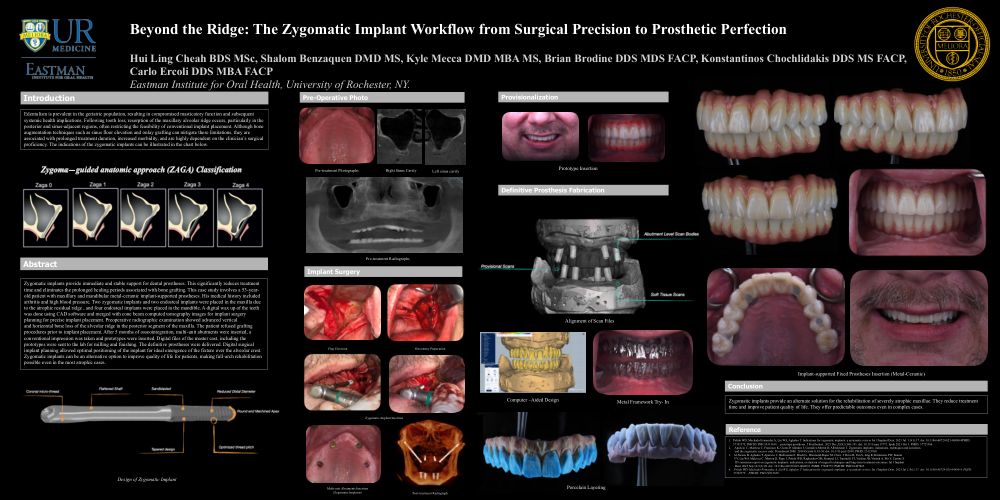
Edentulism is prevalent in the geriatric population, resulting in compromised masticatory function and subsequent systemic health implications. Following tooth loss, resorption of the maxillary alveolar ridge occurs, particularly in the posterior and sinus-adjacent regions, often restricting the feasibility of conventional implant placement. Although bone augmentation techniques such as sinus floor elevation and onlay grafting can mitigate these limitations, they are associated with prolonged treatment duration, increased morbidity, and are highly dependent on the clinician’s surgical proficiency. The indications of the zygomatic implants can be illustrated in the chart below.
Zygomatic implants provide immediate and stable support for dental prostheses. This significantly reduces treatment time and eliminates the prolonged healing periods associated with bone grafting. This case study involves a 53-year-old patient with maxillary and mandibular metal-ceramic implant-supported prostheses. His medical history included arthritis and high blood pressure. Two zygomatic implants and two endosteal implants were placed in the maxilla due to the atrophic residual ridge , and four endosteal implants were placed in the mandible. A digital wax up of the teeth was done using CAD software and merged with cone beam computed tomography images for implant surgery planning for precise implant placement. Preoperative radiographic examination showed advanced vertical
and horizontal bone loss of the alveolar ridge in the posterior segment of the maxilla. The patient refused grafting procedures prior to implant placement. After 5 months of osseointegration, multi-unit abutments were inserted, a conventional impression was taken and prototypes were inserted. Digital files of the master cast, including the prototypes were sent to the lab for milling and finishing. The definitive prostheses were delivered. Digital surgical implant planning allowed optimal positioning of the implant for ideal emergence of the fixture over the alveolar crest. Zygomatic implants can be an alternative option to improve quality of life for patients, making full-arch rehabilitation possible even in the most atrophic cases.