126 posters, 2 topics, 27 sessions, 324 authors, 82 institutions
ePostersLive by SciGen Technologies S.A. All rights reserved.
2025 ACP Annual Session
October 22 - 25, 2025 | New Orleans, US

133
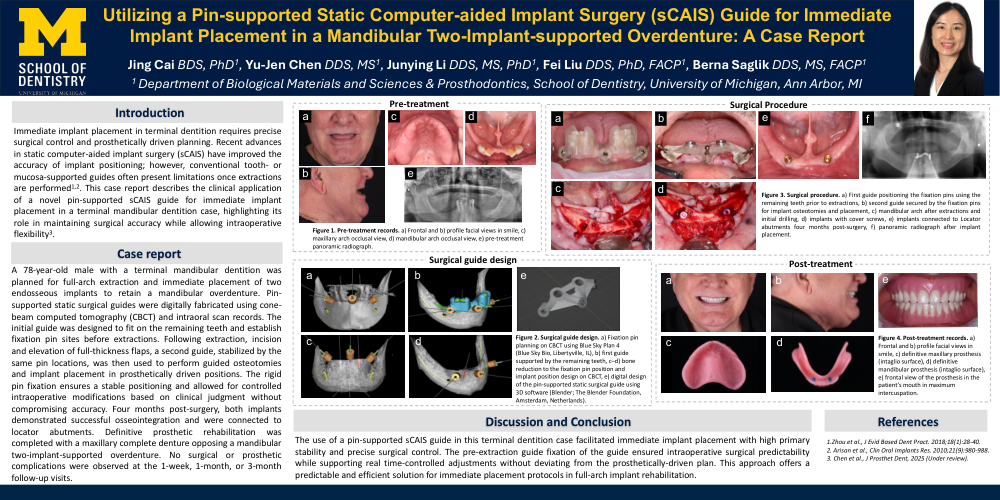
Utilizing a Pin-supported Static Computer-aided Implant Surgery (sCAIS) Guide for Immediate Implant Placement in a Mandibular Two-Implant-supported Overdenture: A Case Report
Poster Presenter
Authors
Affiliations
Part of Topic
Case Presentation
Introduction
Immediate implant placement in terminal dentition requires precise surgical control and prosthetically driven planning. Recent advances in static computer-aided implant surgery (sCAIS) have improved the accuracy of implant positioning; however, conventional tooth- or mucosa-supported guides often present limitations once extractions are performed1,2. This case report describes the clinical application of a novel pin-supported sCAIS guide for immediate implant placement in a terminal mandibular dentition case, highlighting its role in maintaining surgical accuracy while allowing intraoperative flexibility3.
Case report
A 78-year-old male with a terminal mandibular dentition was planned for full-arch extraction and immediate placement of two endosseous implants to retain a mandibular overdenture. Pin-supported static surgical guides were digitally fabricated using cone-beam computed tomography (CBCT) and intraoral scan records. The initial guide was designed to fit on the remaining teeth and establish fixation pin sites before extractions. Following extraction, incision and elevation of full-thickness flaps, a second guide, stabilized by the same pin locations, was then used to perform guided osteotomies and implant placement in prosthetically driven positions. The rigid pin fixation ensures a stable positioning and allowed for controlled intraoperative modifications based on clinical judgment without compromising accuracy. Four months post-surgery, both implants demonstrated successful osseointegration and were connected to locator abutments. Definitive prosthetic rehabilitation was completed with a maxillary complete denture opposing a mandibular two-implant-supported overdenture. No surgical or prosthetic complications were observed at the 1-week, 1-month, or 3-month follow-up visits.
Discussion and Conclusion
The use of a pin-supported sCAIS guide in this terminal dentition case facilitated immediate implant placement with high primary stability and precise surgical control. The pre-extraction guide fixation of the guide ensured intraoperative surgical predictability while supporting real time-controlled adjustments without deviating from the prosthetically-driven plan. This approach offers a predictable and efficient solution for immediate placement protocols in full-arch implant rehabilitation.