126 posters, 2 topics, 27 sessions, 324 authors, 82 institutions
ePostersLive by SciGen Technologies S.A. All rights reserved.
2025 ACP Annual Session
October 22 - 25, 2025 | New Orleans, US

126
Dual Function Digital Occlusal Splint
Poster Presenter
Authors
Affiliations
Part of Topic
Case Presentation
Title: Dual Function Digital Occlusal Splint
Introduction
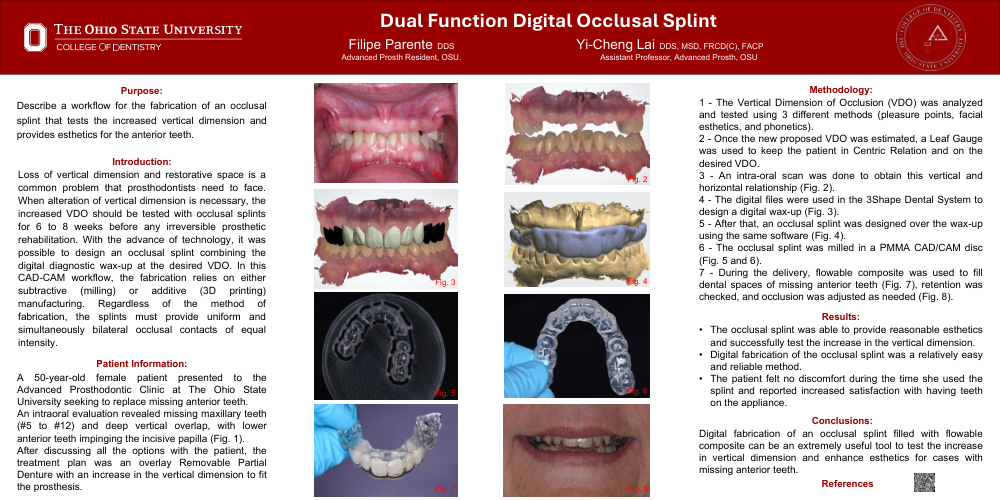
Loss of vertical dimension and restorative space is a common problem that prosthodontists need to face. When alteration of vertical dimension is necessary, the increased VDO should be tested with occlusal splints for 6 to 8 weeks before any irreversible prosthetic rehabilitation. With the advance of technology, it was possible to design an occlusal splint combining the digital diagnostic wax-up at the desired VDO. In this CAD-CAM workflow, the fabrication relies on either subtractive (milling) or additive (3D printing) manufacturing. Regardless of the method of fabrication, the splints must provide uniform and simultaneously bilateral occlusal contacts of equal intensity.
Patient information:
A 50-year-old female patient presented to the Advanced Prosthodontic Clinic at The Ohio State University seeking to replace missing anterior teeth.
An intraoral evaluation revealed missing maxillary teeth (#5 to #12) and deep vertical overlap, with lower anterior teeth impinging the incisive papilla.
After discussing all the options with the patient, the treatment plan was an overlay Removable Partial Denture with an increase in the vertical dimension to fit the prosthesis.
Methods
1 - The Vertical Dimension of Occlusion (VDO) was analyzed and tested using 3 different methods (pleasure points, facial esthetics, and phonetics).
2 - Once the new proposed VDO was estimated, a Leaf Gauge was used to keep the patient in Centric Relation and on the desired VDO.
3 - An intra-oral scan was done to obtain this vertical and horizontal relationship.
4 - The digital files were used in CAD software to design a digital wax-up.
5 - After that, an occlusal splint was designed over the wax-up using the same software.
6 - The occlusal splint was milled in a PMMA CAD/CAM disc.
7 - During the delivery, flowable composite was used to fill dental spaces of missing anterior teeth, retention was checked, and occlusion was adjusted as needed.
Results
The occlusal splint was able to provide reasonable esthetics and successfully test the increase in the vertical dimension.
Digital fabrication of the occlusal splint was a relatively easy and reliable method.
The patient felt no discomfort during the time she used the splint and reported increased satisfaction with having teeth on the appliance in place.
Conclusion
Digital fabrication of occlusal splint can be an extremely useful tool to test the increase in vertical dimension and enhance esthetics for a case with missing anterior teeth.