126 posters, 2 topics, 27 sessions, 324 authors, 82 institutions
ePostersLive by SciGen Technologies S.A. All rights reserved.
2025 ACP Annual Session
October 22 - 25, 2025 | New Orleans, US

117
A Comparative Case report Using Conventional and 3D-Printed Palatal Obturators in a Post-Osteosarcoma Patient
Poster Presenter
Authors
Affiliations
DUMMY, The Ohio State University, DUMMY, The Ohio State University
Part of Topic
Case Presentation
Introduction:
Maxillary resection due to osteosarcoma often results in significant palatal defects, necessitating the use of obturator prostheses to restore oral function and aesthetics. While conventional obturators have long been the standard, digital workflows offer improved precision and efficiency. This case study highlights a unique opportunity to directly compare a traditional and a digitally fabricated obturator in the same patient and in the same visits.
The objective of this poster is to describe and compare the fabrication processes and patient-reported outcomes of a heat-cured conventional palatal obturator versus a digitally designed and 3D-printed obturator in a single post-maxillectomy patient.
Clinical presentation:
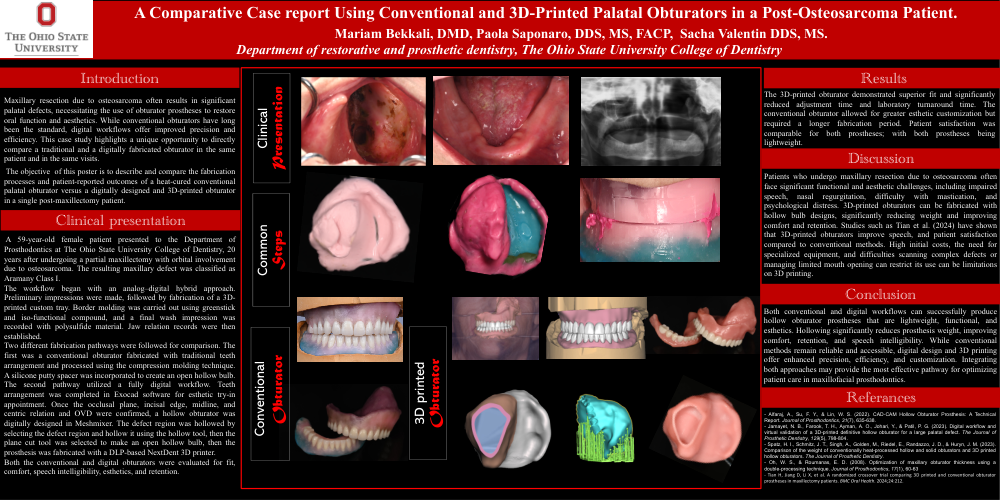
A 59-year-old female patient presented to the Department of Prosthodontics at The Ohio State University College of Dentistry, 20 years after undergoing a partial maxillectomy with orbital involvement due to osteosarcoma. The resulting maxillary defect was classified as Aramany Class I.
The workflow began with an analog–digital hybrid approach. Preliminary impressions were made, followed by fabrication of a 3D-printed custom tray. Border molding was carried out using greenstick and iso-functional compound, and a final wash impression was recorded with polysulfide material. Jaw relation records were then established.
Two different fabrication pathways were followed for comparison. The first was a conventional obturator fabricated with traditional teeth arrangement and processed using the compression molding technique. A silicone putty spacer was incorporated to create an open hollow bulb. The second pathway utilized a fully digital workflow. Teeth arrangement was completed in Exocad software for esthetic try-in appointment. Once the occlusal plane, incisal edge, midline, and centric relation and OVD were confirmed, a hollow obturator was digitally designed in Meshmixer. The defect region was hollowed by selecting the defect region and hollow it using the hollow tool, then the plane cut tool was selected to make an open hollow bulb, then the prosthesis was fabricated with a DLP-based NextDent 3D printer.
Both the conventional and digital obturators were evaluated for fit, comfort, speech intelligibility, esthetics, and retention.
Results:
The 3D-printed obturator demonstrated superior fit and significantly reduced adjustment time and laboratory turnaround time. The conventional obturator allowed for greater esthetic customization but required a longer fabrication period. Patient satisfaction was comparable for both prostheses; with both prostheses being lightweight.
Discussion:
Patients who undergo maxillary resection due to osteosarcoma often face significant functional and aesthetic challenges, including impaired speech, nasal regurgitation, difficulty with mastication, and psychological distress. 3D-printed obturators can be fabricated with hollow bulb designs, significantly reducing weight and improving comfort and retention. Studies such as Tian et al. (2024) have shown that 3D-printed obturators improve speech, and patient satisfaction compared to conventional methods. High initial costs, the need for specialized equipment, and difficulties scanning complex defects or managing limited mouth opening can restrict its use can be limitations on 3D printing.
Conclusion:
Both conventional and digital workflows can successfully produce hollow obturator prostheses that are lightweight, functional, and esthetics. Hollowing significantly reduces prosthesis weight, improving comfort, retention, and speech intelligibility. While conventional methods remain reliable and accessible, digital design and 3D printing offer enhanced precision, efficiency, and customization. Integrating both approaches may provide the most effective pathway for optimizing patient care in maxillofacial prosthodontics.