Loading...

206 posters, 13 topics, 5 sessions, 713 authors, 293 institutions

ePostersLive by SciGen Technologies S.A. All rights reserved.

AAPS 104th Annual Meeting

May 2-5, 2026 | Lihue, HI

AAPS 104th Annual Meeting banner

PC36

Perceptions Of Postoperative Scarring After Gender-affirming Mastectomy
Part of Topic

Gender Affirmation

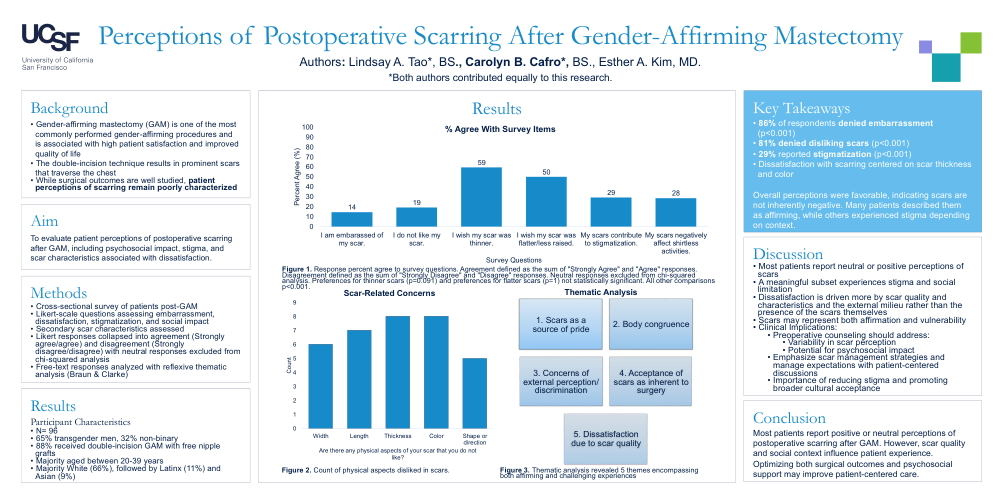
Perceptions of Postoperative Scarring After Gender-Affirming Mastectomy

Authors: Lindsay A. Tao*, BS., Carolyn B. Cafro*, BS., Esther A. Kim, MD.

*Both authors contributed equally to this research.


Background

•Gender-affirming mastectomy (GAM) is one of the most commonly performed gender-affirming procedures and is associated with high patient satisfaction and improved quality of life

•The double-incision technique results in prominent scars that traverse the chest
•While surgical outcomes are well studied, patient perceptions of scarring remain poorly characterized

Aim

To evaluate patient perceptions of postoperative scarring after GAM, including psychosocial impact, stigma, and scar characteristics associated with dissatisfaction.

Methods

•Cross-sectional survey of patients post-GAM
•Likert-scale questions assessing embarrassment, dissatisfaction, stigmatization, and social impact
•Secondary scar characteristics assessed
•Likert responses collapsed into agreement (Strongly agree/agree) and disagreement (Strongly disagree/disagree) with neutral responses excluded from chi-squared analysis
•Free-text responses analyzed with reflexive thematic analysis (Braun & Clarke)
 

Results

Participant Characteristics

•N= 96
•65% transgender men, 32% non-binary
•88% received double-incision GAM with free nipple grafts
•Majority aged between 20-39 years
•Majority White (66%), followed by Latinx (11%) and Asian (9%)
 

Key Takeaways

•86% of respondents denied embarrassment (p<0.001)
•81% denied disliking scars (p<0.001)
•29% reported stigmatization (p<0.001)
•Dissatisfaction with scarring centered on scar thickness and color
•

Overall perceptions were favorable, indicating scars are not inherently negative. Many patients described them as affirming, while others experienced stigma depending on context.

Discussion

•Most patients report neutral or positive perceptions of scars
•A meaningful subset experiences stigma and social limitation
•Dissatisfaction is driven more by scar quality and characteristics and the external milieu rather than the presence of the scars themselves
•Scars may represent both affirmation and vulnerability
•Clinical Implications:
•Preoperative counseling should address:
•Variability in scar perception
•Potential for psychosocial impact
•Emphasize scar management strategies and manage expectations with patient-centered discussions
•Importance of reducing stigma and promoting broader cultural acceptance
 

Conclusion

Most patients report positive or neutral perceptions of postoperative scarring after GAM. However, scar quality and social context influence patient experience. Optimizing both surgical outcomes and psychosocial support may improve patient-centered care.

aaps2026 banner
Copyright © 2015-2026, ePostersLive® SciGen is a registered trademark of SciGen Technologies S.A. Patent pending.

This website and third-party tools we use rely on cookies for the best user experience. By selecting "I agree", you agree to cookie usage as described in our Privacy Policy.