206 posters, 13 topics, 5 sessions, 713 authors, 293 institutions
ePostersLive by SciGen Technologies S.A. All rights reserved.
AAPS 104th Annual Meeting
May 2-5, 2026 | Lihue, HI

PC35
Age-related Differences In Decisional Regret After Gender-affirming Mastectomy
Poster Presenter
Authors
Austin McBride, Carolyn Cafro, Lindsay Tao, Fabian Ramirez, Laura Chen, Hailey Johnson, Chelsea Yim, Charlie Dubach-Reinhold, Esther Kim
Affiliations
UCSF, University of California, San Francisco, Department of Surgery, Division of Plastic and Reconstructive Surgery, San Francisco, CA, USA, University of Rochester School of Medicine and Dentistry, Rochester, NY, USA, Loyola University Chicago Stritch School of Medicine, Maywood, IL, USA
Part of Topic
Gender Affirmation
Quality of Life and Decisional Regret After Gender-Affirming Mastectomy Across Age Groups
Austin McBride1, Carolyn Cafro2, Lindsay Tao1, Fabian Ramirez1, Laura Chen1, Hailey Johnson1, Chelsea Yim3, Charlie Dubach-Reinhold1, Esther A. Kim, MD1
University of California, San Francisco, San Francisco, CA; University of Rochester School of Medicine and Dentistry, Rochester, NY; Loyola University Chicago Stritch School of Medicine, Maywood, IL
Background
Gender-affirming mastectomy (GAM) is the most commonly performed gender-affirming surgery in the United States and has been shown to reduce gender dysphoria and improve quality of life. The UCSF GenderQoL instrument was developed to evaluate multidimensional postoperative outcomes across domains of Gender Identity, Social Health, Satisfaction with Physical Appearance, and Recovery from Surgery. While the initial validation study demonstrated favorable outcomes across these domains, age-stratified patient-reported outcomes have not yet been evaluated. In addition to GenderQoL domains, decisional regret was assessed as a complementary patient-reported outcome. This study evaluated domain-level quality-of-life outcomes and decisional regret across age groups to determine whether age at surgery influences postoperative experiences following GAM.
Methods
A cross-sectional survey was administered to a single-surgeon cohort of patients aged 15-59 who underwent GAM ≥1 year prior. The survey comprised the UCSF GenderQoL instrument, Decision Regret Scale, and Satisfaction with Decision measures. Domain-level composite scores and decisional regret scores were compared across age groups using Kruskal-Wallis with Dunn’s post hoc testing. Higher scores reflected greater quality of life and satisfaction, and lower decisional regret.
Results
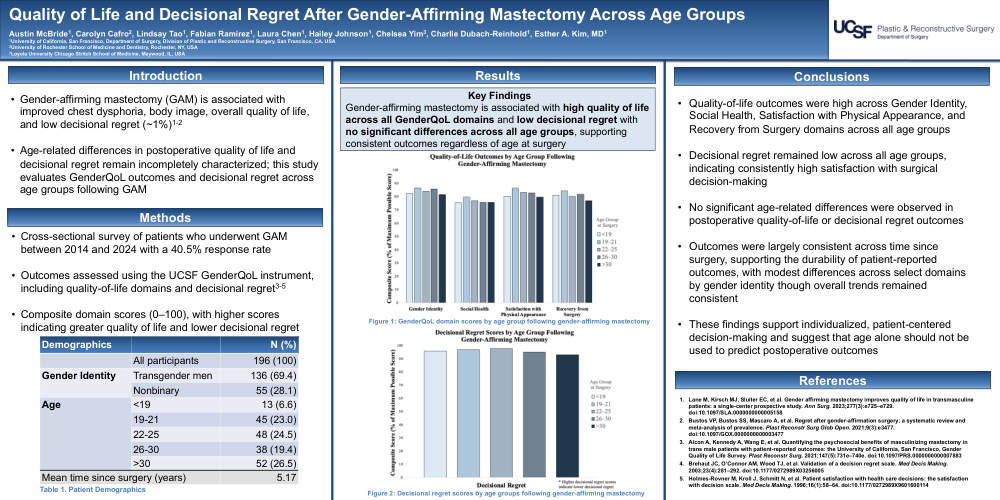
A total of 196 participants completed the survey. At the time of surgery, 7% were <19-years-old, 23% were 19-21, 24% were 22-25, 19% were 26-30, and 27% were >30 years-old. Participants completed the survey a mean of 5.17 years postoperatively (range 1–10 years). Most participants identified as transgender men (70%) or nonbinary (28%). The cohort was predominantly White (66%) and non-Hispanic (82%). The most common surgical technique was double incision mastectomy (DIM) with free nipple grafts (FNG) (80%), followed by DIM without FNG (11%) and periareolar incision (9%). Across age groups, mean domain-level composite scores were high, ranging from 76%-88% across Gender Identity, Social Health, Satisfaction with Physical Appearance, and Recovery from Surgery domains. Domain-level composite scores did not differ significantly between age groups (all p>0.05). Overall decisional regret was low, with no significant differences across age groups (p>0.05).
Conclusions
Quality-of-life outcomes following GAM were consistently high across age groups, with no meaningful differences at the domain level based on age at surgery. Decisional regret was similarly low across all age groups. These findings provide age-stratified evidence supporting equitable access to gender-affirming surgery, inform surgical counseling, and strengthen shared decision-making for patients considering GAM.