206 posters, 13 topics, 5 sessions, 713 authors, 293 institutions
ePostersLive by SciGen Technologies S.A. All rights reserved.
AAPS 104th Annual Meeting
May 2-5, 2026 | Lihue, HI

D129
Psychological And Quality-of-life Outcomes Following Targeted Muscle Reinnervation For Neuropathic Pain
Poster Presenter
Authors
Floris Raasveld, Tsong-Hann Yu, Jim Ho, Maximilian Mayrhofer-Schmid, Barbara Gomez-Eslava, Clifford Woolf, William Renthal, David Hao, Ian L. Valerio, Kyle R. Eberlin
Affiliations
Massachusetts General Hospital, Massachusetts General Hospital, Boston, Boston Children's Hospital, Boston, Brigham and Women's Hospital, Boston
Part of Topic
Psychological And Quality-of-life Outcomes Following Targeted Muscle Reinnervation For Neuropathic Pain
Introduction
Neuropathic pain is often accompanied by impaired sleep, anxiety, depression, and reduced quality of life. Although targeted muscle reinnervation (TMR) is effective for preventing and treating neuropathic pain in both amputees and non-amputees, its impact on psychosocial outcomes remains incompletely understood. This study evaluated changes in psychological well-being, sleep, and quality of life following TMR.
Methods
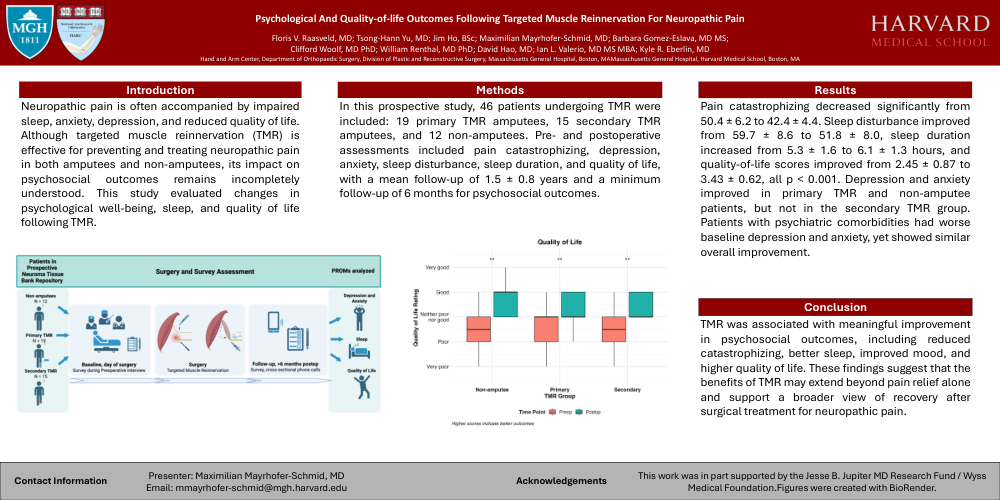
In this prospective study, 46 patients undergoing TMR were included: 19 primary TMR amputees, 15 secondary TMR amputees, and 12 non-amputees. Pre- and postoperative assessments included pain catastrophizing, depression, anxiety, sleep disturbance, sleep duration, and quality of life, with a mean follow-up of 1.5 ± 0.8 years and a minimum follow-up of 6 months for psychosocial outcomes.
Results
Pain catastrophizing decreased significantly from 50.4 ± 6.2 to 42.4 ± 4.4. Sleep disturbance improved from 59.7 ± 8.6 to 51.8 ± 8.0, sleep duration increased from 5.3 ± 1.6 to 6.1 ± 1.3 hours, and quality-of-life scores improved from 2.45 ± 0.87 to 3.43 ± 0.62, all p < 0.001. Depression and anxiety improved in primary TMR and non-amputee patients, but not in the secondary TMR group. Patients with psychiatric comorbidities had worse baseline depression and anxiety, yet showed similar overall improvement.
Conclusion
TMR was associated with meaningful improvement in psychosocial outcomes, including reduced catastrophizing, better sleep, improved mood, and higher quality of life. These findings suggest that the benefits of TMR may extend beyond pain relief alone and support a broader view of recovery after surgical treatment for neuropathic pain.