206 posters, 13 topics, 5 sessions, 713 authors, 293 institutions
ePostersLive by SciGen Technologies S.A. All rights reserved.
AAPS 104th Annual Meeting
May 2-5, 2026 | Lihue, HI

D45
Intralesional Steroid Therapy Reduces Stricture Following Gender-affirming Vaginoplasty In Patients With Keloid History
Part of Topic
Gender Affirmation
BACKGROUND:
Gender-affirming vaginoplasty carries risk of wound-related complications, including granulation tissue, neovaginal stricture, and introital stenosis.1 While traditional risk factors such as smoking and diabetes have been studied, the impact of aberrant wound healing phenotypes remains unclear. Given shared fibroproliferative pathways between keloid/hypertrophic scarring (KHS) and stricture formation,2 the present study sought to evaluate whether a preoperative history of KHS independently predicts postoperative complications following vaginoplasty and whether intralesional steroids attenuate risk.
METHODS:
Study Design
A retrospective review was performed of all patients who had undergone primary vaginoplasty at a single academic center between 2017 and 2023.
Variables
The primary outcome was incidence of postoperative stricture or stenosis. Exposures of interest included patient history of keloids or hypertrophic scarring and postoperative intralesional steroid injection.
Statistical Analysis
Firth logistic regression assessed the association between KHS history and complications, adjusting for age, body mass index (BMI), smoking history, diabetes mellitus (DM), and race. This was followed by a sensitivity analysis including both a postoperative steroid and a keloid + steroid interaction term to account for treatment effects. Statistical significance was set at p<0.05.
RESULTS:
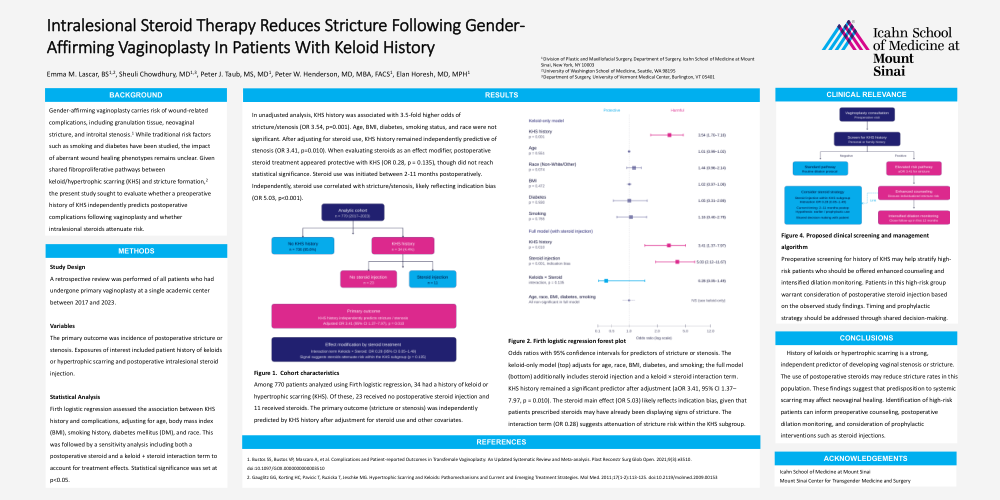
In unadjusted analysis, KHS history was associated with 3.5-fold higher odds of stricture/stenosis (OR 3.54, p=0.001). Age, BMI, diabetes, smoking status, and race were not significant. After adjusting for steroid use, KHS history remained independently predictive of stenosis (OR 3.41, p=0.010). When evaluating steroids as an effect modifier, postoperative steroid treatment appeared protective with KHS (OR 0.28, p = 0.135), though did not reach statistical significance. Steroid use was initiated between 2-11 months postoperatively. Independently, steroid use correlated with stricture/stenosis, likely reflecting indication bias (OR 5.03, p<0.001).
CLINICAL RELEVANCE:
Preoperative screening for history of KHS may help stratify high-risk patients who should be offered enhanced counseling and intensified dilation monitoring. Patients in this high-risk group warrant consideration of postoperative steroid injection based on the observed study findings. Timing and prophylactic strategy should be addressed through shared decision-making.
CONCLUSIONS:
History of keloids or hypertrophic scarring is a strong, independent predictor of developing vaginal stenosis or stricture. The use of postoperative steroids may reduce stricture rates in this population. These findings suggest that predisposition to systemic scarring may affect neovaginal healing. Identification of high-risk patients can inform preoperative counseling, postoperative dilation monitoring, and consideration of prophylactic interventions such as steroid injections.