203 posters, 14 topics, 5 sessions, 817 authors, 256 institutions
ePostersLive by SciGen Technologies S.A. All rights reserved.
The AAPS 102nd Annual Meeting
May 18-21, 2024 | The Westin Copley Place, Boston, MA

P60
Persistent Lvad Pocket And Driveline Site Infections After Orthotopic Heart Transplant Benefit From Surgical Management
Poster Presenter
Authors
James Butterfield, Raquel Arias-Camison, Keith Sweitzer, Jose G Christiano
Affiliations
Part of Topic
General Reconstruction/ Gender Affirmation
Persistent LVAD Pocket and Driveline Site Infection
Following LVAD removal and Orthotopic Heart Transplant
Background:
Approximately one half of all patients with LVADs will have a driveline infection at some point during their life. (1) While chronic left ventricular assist device (LVAD) driveline infection is a common complication in patients who receive LVAD therapy, the definitive management is removal of the implant, generally at the time of orthotopic heart transplant (OHT). (2)
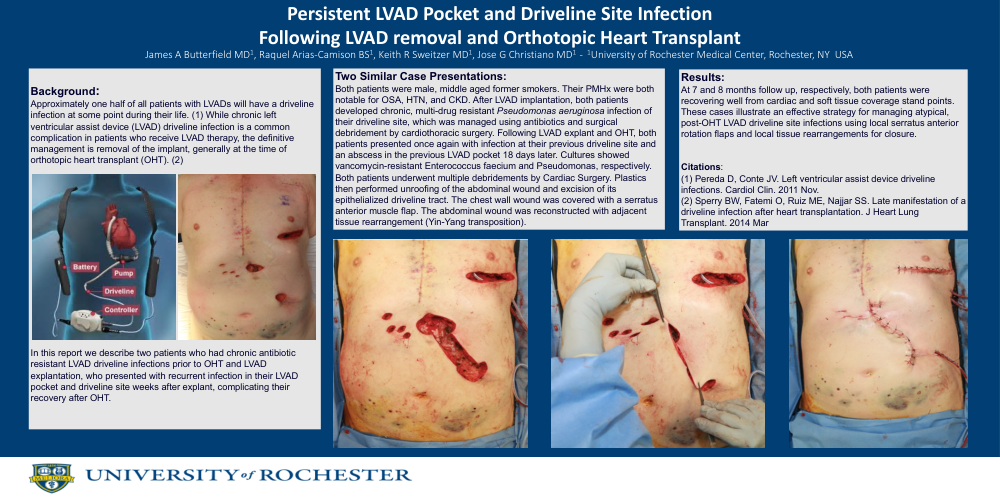
In this report we describe two patients who had chronic antibiotic resistant LVAD driveline infections prior to OHT and LVAD explantation, who presented with recurrent infection in their LVAD pocket and driveline site weeks after explant, complicating their recovery after OHT.
Two Similar Case Presentations:
Both patients were male, middle aged former smokers. Their PMHx were both notable for OSA, HTN, and CKD. After LVAD implantation, both patients developed chronic, multi-drug resistant Pseudomonas aeruginosa infection of their driveline site, which was managed using antibiotics and surgical debridement by cardiothoracic surgery. Following LVAD explant and OHT, both patients presented once again with infection at their previous driveline site and an abscess in the previous LVAD pocket 18 days later. Cultures showed vancomycin-resistant Enterococcus faecium and Pseudomonas, respectively. Both patients underwent multiple debridements by Cardiac Surgery. Plastics then performed unroofing of the abdominal wound and excision of its epithelialized driveline tract. The chest wall wound was covered with a serratus anterior muscle flap. The abdominal wound was reconstructed with adjacent tissue rearrangement (Yin-Yang transposition).
Results:
At 7 and 8 months follow up, respectively, both patients were recovering well from cardiac and soft tissue coverage stand points. These cases illustrate an effective strategy for managing atypical, post-OHT LVAD driveline site infections using local serratus anterior rotation flaps and local tissue rearrangements for closure.
Citations:
(1) Pereda D, Conte JV. Left ventricular assist device driveline infections. Cardiol Clin. 2011 Nov.
(2) Sperry BW, Fatemi O, Ruiz ME, Najjar SS. Late manifestation of a driveline infection after heart transplantation. J Heart Lung Transplant. 2014 Mar