203 posters, 14 topics, 5 sessions, 817 authors, 256 institutions
ePostersLive by SciGen Technologies S.A. All rights reserved.
The AAPS 102nd Annual Meeting
May 18-21, 2024 | The Westin Copley Place, Boston, MA

P59
Surgical Management Of Biopolymer Induced Hypercalcemia And Renal Insufficiency: A Case Series
Poster Presenter
Part of Topic
General Reconstruction/ Gender Affirmation
Purpose:
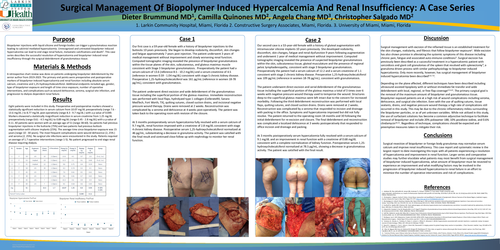
Biopolymer injections with liquid silicone and foreign bodies can trigger a granulomatous reaction leading to calcitriol mediated hypercalcemia. Unrecognized and untreated biopolymer induced hypercalcemia can lead to end stage renal failure, metastatic calcifications and death1. This case series describes the successful resolution of hypercalcemia and biopolymer induced renal insufficiency through the surgical debridement of granulomatous tissue.
Materials & Methods:
A retrospective chart review was done on patients undergoing biopolymer debridement by the senior author from 2019-2023. The primary end points were preoperative and postoperative markers of biopolymer induced hypercalcemia and renal function including absolute serum calcium, creatinine and 1,25-hydroxycholecalciferol. Additional endpoints included age, gender, type of biopolymer exposure and length of time since exposure, number of operative interventions, and complications such as wound dehiscence, seroma, surgical site infection, and progression to dialysis dependent renal failure.
Results:
Eight patients were included in this study. Preoperative and postoperative markers showed a statistically significant reduction in serum calcium from 10.07 mg/dL preoperatively (range 7.6 - 13.6 mg/dL ) to 8.77 mg/dL post operatively (range 8.3 - 9.7 mg/dL ) with a p value of 0.049. Markers showered a statistically insignificant reduction in serum creatinine from 1.25 mg/dL preoperatively (range 0.61 - 4.5 mg/dL) to 0.89 mg/dL (range 0.45 - 2.8 mg/dL) with a p value of 0.11. All patients were women with an average age of 51 (range 38-60). Six patients had previous biopolymer injections in the buttocks (75%) and two patients had previous buttock augmentation with silicone implants (25%). The average time since biopolymer exposure was 15 years (range 10 - 30 years). The most frequent complications were wound dehiscence (2, 25% ) and seroma (2, 25%). No surgical site infections were encountered in the study. Patients required an average of 1.7 operative interventions (range 1-5). No patient progressed to end stage renal disease requiring dialysis.
Case 1:
Our first case is a 59 year-old female with a history of biopolymer injections to the buttocks 10 years previously. She began to develop nodularity, discomfort, skin changes and fatigue approximately 7 years post injection. The patient underwent 3 years of medical management without improvement and slowly worsening renal function. Computed tomographic imaging revealed the presence of biopolymer granulomatosis within the tissue planes of the skin, subcutaneous, and gluteus maximus muscle consistent with Stage 3 biopolymer granulomatosis. Preoperatively the patient had a serum calcium of 13.6 (reference 8.5 - 10.2 mg/dL) and a serum creatinine of 4.5 (reference in women 0.59 - 1.04 mg/dL) consistent with stage 5 chronic kidney disease. Preoperative 1,25-hydroxycholecalciferol was 161 pg/mL (reference in women 18-78 pg/mL), consistent with granulomatosis. The patient underwent direct excision and wide debridement of the granulomatous tissue including the superficial portion of the gluteus maximus. Immediate reconstruction was performed with local flaps, hydrolyzed type 1 collagen (CellerateRX, Sanara MedTech, Fort Worth, TX), quilting sutures, closed suction drains, and incisional negative pressure wound therapy. Drains were removed at 2 weeks. Reconstruction was complicated by a seroma and dehiscence at 4 weeks post-operatively. The patient was taken back to the operating room with revision of the closure. At 3 months postoperatively serum hypercalcemia fully resolved with a serum calcium of 9.7 mg/dL, renal function improved with a creatinine of 2.8 mg/dL consistent with stage 4 chronic kidney disease. Postoperative serum 1,25-hydroxycholecalciferol normalized at 46 pg/mL, substantiating a decrease in granuloma activity. The patient was satisfied with the final result and continued close follow up with nephrology to monitor her renal function.
Case 2:
Our second case is a 53-year-old female with a history of gluteal augmentation with intramuscular silicone implants 10 years previously. She developed nodularity, discomfort, skin changes, fatigue and renal dysfunction 9 years following augmentation and underwent 1 year of medical management without improvement. Computed tomographic imaging revealed the presence of suspected biopolymer granulomatosis within the skin, subcutaneous tissue, gluteal musculature and the presence of regional pelvic lymphadenopathy, consistent with stage 3 biopolymer granulomatosis. Preoperatively the patient had a serum calcium of 12.2 and a serum creatinine of 1.1 consistent with stage 2 chronic kidney disease. Preoperative 1,25-hydroxycholecalciferol was 109 pg/mL (reference in women 18-78 pg/mL), consistent with granulomatosis. The patient underwent direct excision and serial debridement of the granulomatous tissue including the superficial portion of the gluteus maximus a total of 3 times over 6 weeks with negative pressure wound therapy used to temporize the wound. Structures deep to the superficial gluteus maximus were left intact due to the concern for increased morbidity. Following the third debridement reconstruction was performed with local flaps, quilting sutures, and closed suction drains. Drains were removed at 2 weeks. Reconstruction was complicated by a seroma that responded to incision and drainage with packing in the office. Symptoms and hypercalcemia improved but did not fully resolve. The patient returned to the operating room 18 months and 30 following the initial debridement for re-excision and closure. The final debridement and reconstruction was complicated a localized dehiscence at 3 weeks postoperatively that responded to office incision and drainage and packing. At 3 months postoperatively serum hypercalcemia fully resolved with a serum calcium of 9.1 mg/dL and an improvement in renal function with a creatinine of 0.68 mg/dL consistent with a complete normalization of kidney function. Postoperative serum 1,25-hydroxycholecalciferol normalized at 78.5 pg/mL, showing a decrease in granulomatous activity. The patient was satisfied with the final result.
Discussion:
Surgical management with excision of the inflamed tissue is an established treatment for the skin changes, nodularity, and fibrosis that follow biopolymer exposure2. Wide excision has also shown promise in alleviating the systemic symptoms of this disease including chronic pain, fatigue and associated auto-immune conditions3. Surgical excision has previously been described as a successful treatment in a hypercalcemic patient with sarcoidosis and giant cell granulomas of the spleen that resolved with splenectomy4, a granuloma driven process with similar pathophysiology to biopolymer induced hypercalcemia. Only more recently, however, has surgical management of biopolymer induced hypercalcemia been described5,6,7,8.
Depending on the plane affected, different techniques have been described including ultrasound assisted lipoplasty with or without immediate fat transfer and wide debridement with local, regional, or free flap coverage2,5,6,9. The primary surgical goal is the removal of the maximum amount of biopolymer and granulomatous tissue. Biopolymer exposed patients are at a high risk of wound complications including seroma, dehiscence, and surgical site infection. Even with the use of quilting sutures, tissue sealants, drains, and negative pressure wound therapy a high rate of complications still occurred in this study. This may be due to the chronic inflammatory milieu surrounding the biopolymer particles, or as of yet unknown variables. While not utilized in this study, the use of surfactant solutions has become a common adjunctive technique to facilitate removal of biopolymer and include 20% poloxamer 188, 10% povidone-iodine, and 0.6% clindamycin10,11. Regardless of technique, complications should be expected and preemptive measures taken to mitigate their risk.
Conclusions:
Surgical resection of biopolymer or foreign body granulomas may normalize serum calcium and improve renal insufficiency. This case report and systematic review is the largest report to date investigating this topic with all patients experiencing a resolution of hypercalcemia and improvement in renal function. Larger series and comparative studies may further elucidate what patients may most benefit from surgical management of biopolymer induced hypercalcemia, what amount of biopolymer must be resected to experience an improvement and what modifying factors may be involved in the progression of biopolymer induced hypercalcemia to renal failure in an effort tominimize the number of operative interventions and risk of complications.
References: