212 posters, 10 topics, 5 sessions, 754 authors, 237 institutions
ePostersLive by SciGen Technologies S.A. All rights reserved.
The AAPS 101st Annual Meeting
29 April – 2 May, 2023 | Chicago, IL

D35
Predictors Of Hand Therapy Non-Compliance Following Flexor Tendon Repair: A Retrospective Cohort Study
Poster Presenter
Part of Topic
Hand/Extremity
Predictors of Hand Therapy Non-Adherence Following Flexor Tendon Repair:
A Retrospective Cohort Study
Matthew T. McLaughlin, BS, Steven P. Moura, MA, Armin Edalatpour, MD, Allison J. Seitz, BS, Amy Brossard, OTR/L, CHT, Brett F. Michelotti, MD
University of Wisconsin School of Medicine and Public Health, Department of Surgery, Division of Plastic and Reconstructive Surgery
Background
•Though the best rehabilitation protocol following surgical repair of traumatic flexor tendon injuries is still debated, it is widely agreed that early mobilization under the guidance of occupational therapy (OT) helps prevent secondary tendon ruptures and promotes better functional results including range of motion.
•Despite this demonstrated importance, many patients are nonadherent to rehabilitative protocols, and the specific factors that affect OT adherence following flexor tendon repair are not well understood.
•The primary objective of this study is to examine predictors of patient non-adherence with hand therapy following repair of traumatic flexor tendon injuries.
•We hypothesized that patients with no health insurance or with Medicaid coverage would have an increased no-show rate to OT appointments following flexor tendon repair surgery compared to patients with Medicare, private health insurance, or worker’s compensation coverage.
Methods
•This retrospective cohort study included 154 patients who underwent surgical repair of flexor tendon injuries at a level I trauma center between January 2015 and January 2020.
•A manual chart review was performed to collect demographic data, insurance status, injury characteristics, and details of the postoperative course including health care utilization.
Results
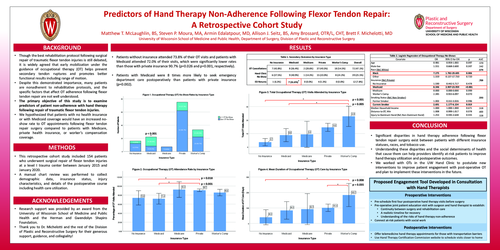
•Patients without insurance attended 73.8% of their OT visits and patients with Medicaid attended 72.0% of their visits, which were significantly lower rates than those with private insurance 90.7% (p=0.026 and p=0.001, respectively).
•Patients with Medicaid were 8 times more likely to seek emergency department care postoperatively than patients with private insurance (p=0.002).
Conclusions
•Significant disparities in hand therapy adherence following flexor tendon repair surgery exist between patients with different insurance statuses, races, and tobacco use.
•Understanding these disparities and the social determinants of health that cause them can help providers identify at-risk patients to improve hand therapy utilization and postoperative outcomes.
•We worked with OTs in the UW Hand Clinic to postulate new interventions to improve patient engagement with post-operative OT and plan to implement these interventions in the future.
Acknowledgements
•Research support was provided by an award from the University of Wisconsin School of Medicine and Public Health and the Herman and Gwendolyn Shapiro Foundation.
•Thank you to Dr. Michelotti and the rest of the Division of Plastic and Reconstructive Surgery for their generous support, guidance, and collegiality!