212 posters, 10 topics, 5 sessions, 754 authors, 237 institutions
ePostersLive by SciGen Technologies S.A. All rights reserved.
The AAPS 101st Annual Meeting
29 April – 2 May, 2023 | Chicago, IL

D34
Getting Out Of Hand? The Association Of Opiate Use With Soft Tissue Infections: A Nationwide Readmissions Database Analysis
Part of Topic
Hand/Extremity
Introduction: Our practice has observed more hand surgery consultations in the context of opioid use that mirrors the growing opioid epidemic. Injection drug use has been shown to be associated with the need for greater healthcare utilization.
Objectives: This study aimed to quantify the national burden of upper extremity infections and outcomes with respect to opioid use.
Methods:The Healthcare Cost and Utilization Project National Readmissions Database from 2015 – 2019 was queried for all primary hospitalizations for upper extremity soft tissue infections (UEI) using ICD-10 codes. Patients were stratified by history of opioid use. Demographics, hospital characteristics, procedures during admission, length of stay, costs, and readmissions were compared. Logistic regression was performed while controlling for patient level confounders such as age, sex, income, trauma admission, Injury Severity Score, elixhauser comorbidity index, AHQ provided illness severity index, and hospital level confounders such as bed size, urban setting, and teaching status
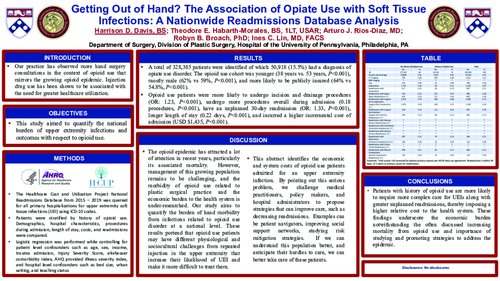
Results:A total of 328,385 patients were identified of which 50,918 (15.5%) had a diagnosis of opiate use disorder. The opioid use cohort was younger (38 years vs. 53 years, P<0.001), mostly male (62% vs 59%, P<0.001), and more likely to be publicly insured (64% vs 54.8%, P<0.001). Opioid use patients were more likely to undergo incision and drainage procedures (OR: 1.23, P<0.001), undergo more procedures overall during admission (0.18 procedures, P<0.001), have an unplanned 30-day readmission (OR: 1.33, P<0.001), longer length of stay (0.22 days, P<0.001), and incurred a higher incremental cost of admission (USD $1,435, P<0.001).
Discussion: The opioid epidemic has attracted a lot of attention in recent years, particularly its associated mortality. However, management of this growing population remains to be challenging, and the morbidity of opioid use related to plastic surgical practice and the economic burden to the health system is under-researched. Our study aims to quantify the burden of hand morbidity from infections related to opioid use disorder at a national level. These results portend that opioid use patients may have different physiological and sociocultural challenges from repeated injection in the upper extremity that increase their likelihood of UEI and make it more difficult to treat them. This abstract identifies the economic and system costs of opioid use patients admitted for an upper extremity infection. By pointing out this serious problem, we challenge medical practitioners, policy makers, and hospital administrators to propose strategies that can improve care, such as decreasing readmissions. Examples can be patient navigators, improving social support networks, studying risk mitigation strategies. If we can understand this population better, and anticipate their hurdles to care, we can better take care of these patients.
Conclusions:Patients with history of opioid use are more likely to require more complex care for UEIs along with greater unplanned readmissions, thereby imposing a higher relative cost to the health system. These findings underscore the economic burden notwithstanding the often discussed increasing mortality from opioid use and importance of studying and promoting strategies to address the epidemic.