212 posters, 10 topics, 5 sessions, 754 authors, 237 institutions
ePostersLive by SciGen Technologies S.A. All rights reserved.
The AAPS 101st Annual Meeting
29 April – 2 May, 2023 | Chicago, IL

D17
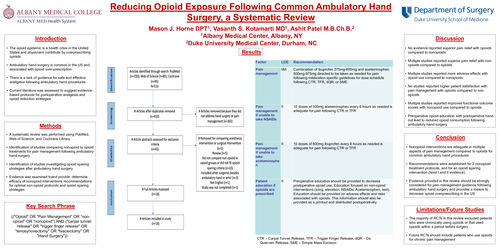
Reducing Opioid Exposure Following Common Ambulatory Hand Surgery - A Systematic Review
Poster Presenter
Authors
Affiliations
Part of Topic
Hand/Extremity
Reducing Opioid Exposure Following Common Ambulatory Hand Surgery, a Systematic Review.
Mason J. Horne DPT1, Vasanth S. Kotamarti MD1, Ashit Patel M.B.Ch.B.2
1Albany Medical Center, Albany, NY
2Duke University Medical Center, Durham, NC
Introduction
The opioid epidemic is a health crisis in the United States and physicians contribute by overprescribing opioids
Ambulatory hand surgery is common in the US and associated with opioid over-prescription
There is a lack of guidance for safe and effective analgesia following ambulatory hand procedures
Current literature was assessed to suggest evidence-based protocols for postoperative analgesia and opioid reduction strategies
Methods
A systematic review was performed using PubMed, Web of Science, and Cochrane Library
Identification of studies comparing nonopioid to opioid treatments for pain management following ambulatory hand surgery
Identification of studies investigating opioid sparing strategies after ambulatory hand surgery
Evidence was examined toand provide determine efficacy of nonopioid interventions recommendations for optimal non-opioid protocols and opioid sparing strategies
Key Search Phrase
(("Opioid" OR "Pain Management” OR “non-opioid” OR “nonopioid") AND ("carpal tunnel release" OR "trigger finger release" OR "tenosynovectomy" OR "fasciectomy" OR "Hand Surgery"))
Discussion
No evidence reported superior pain relief with opioids compared to nonopioids
Multiple studies reported superior pain relief with non-opioids compared to opioids
Multiple studies reported more adverse effects with opioid use compared to nonopioids
No studies reported higher patient satisfaction with pain management with opioids compared to non-opioids
Multiple studies reported improved functional outcome scores with nonopioid use compared to opioids
Preoperative opioid education with postoperative hand out lead to reduced opioid consumption following ambulatory hand surgery
Conclusion
Nonopioid interventions are adequate in multiple aspects of pain management compared to opioids for common ambulatory hand procedures
Recommendations were established for 2 nonopioid treatment protocols, and for an opioid sparing intervention (level I and II evidence)
Evidence provided in this review should be strongly considered for pain management guidance following ambulatory hand surgery and provides a means to decrease opioid overprescribing in the US
Limitations/Future Studies
The majority of RCTs in this review excluded patients who were chronically using opioids or that used opioids within a period before surgery
Future RCTs should include patients who use opioids for chronic pain management