212 posters, 10 topics, 5 sessions, 754 authors, 237 institutions
ePostersLive by SciGen Technologies S.A. All rights reserved.
The AAPS 101st Annual Meeting
29 April – 2 May, 2023 | Chicago, IL

D16
The Impact Of The American College Of Radiology's Appropriateness Criteria On The Use Of Magnetic Resonance Imaging For Wrist Pain: An Interrupted Time Series Analysis
Poster Presenter
Part of Topic
Hand/Extremity
The Impact of ACR Appropriateness Criteria on the Use of MRI for Wrist Pain: An Interrupted Time Series Analysis
Meghan N. Cichocki, BS1, Trista M. Benitez, MPH,1 Weijia Jin, BS,2 Anne V. Seyferth, BS,1 Lu Wang, PhD,2 Kevin C. Chung, MD, MS,1 Erika D. Sears, MD, MS1
1.Section of Plastic Surgery, Department of Surgery, University of Michigan Medical School, Ann Arbor, MI, USA
2. Department of Biostatistics, University of Michigan School of Public Health, Ann Arbor, MI, USA
Study Purpose:
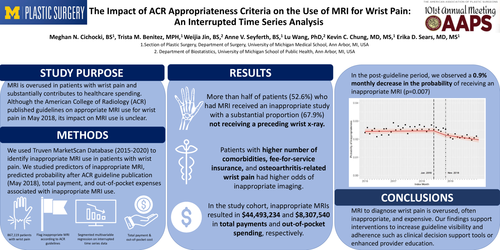
MRI is overused in patients with wrist pain and substantially contributes to healthcare spending. Although the American College of Radiology (ACR) published guidelines on appropriate MRI use for wrist pain in May 2018, its impact on MRI use is unclear.
Methods:
We used Truven MarketScan Database (2015-2020) to identify inappropriate MRI use in patients with wrist pain. We studied predictors of inappropriate MRI, predicted probability after ACR guideline publication (May 2018), total payment, and out-of-pocket expenses associated with inappropriate MRI use.
Results:
More than half of patients (52.6%) who had MRI received an inappropriate study with a substantial proportion (67.9%) not receiving a preceding wrist x-ray.
Patients with higher number of comorbidities, fee-for-service insurance, and osteoarthritis-related wrist pain had higher odds of inappropriate imaging.
In the study cohort, inappropriate MRIs resulted in $44,493,234 and $8,307,540 in total payments and out-of-pocket spending, respectively.
In the post-guideline period, we observed a 0.9% monthly decrease in the probability of receiving an inappropriate MRI (p=0.007).
Conclusions:
MRI to diagnose wrist pain is overused, often inappropriate, and expensive. Our findings support interventions to increase guideline visibility and adherence such as clinical decision support tools or enhanced provider education.