212 posters, 10 topics, 5 sessions, 754 authors, 237 institutions
ePostersLive by SciGen Technologies S.A. All rights reserved.
The AAPS 101st Annual Meeting
29 April – 2 May, 2023 | Chicago, IL

D9
Gait Impairments Seen In Diabetic Neuropathy Patients After Surgical Intervention For Open Wounds
Poster Presenter
Authors
Affiliations
Part of Topic
Hand/Extremity
Gait Impairments Seen in Diabetic Neuropathy Patients after Surgical Intervention for Open Wounds
Abstract
PURPOSE: Identifying gait impairments at different levels of neuropathy guides clinicians to prophylactically treat neuropathy symptoms. This is the first large-scale study to quantify the gait parameters based on the degree of neuropathy.
Methods: Levels of neuropathy in diabetic patients were defined as “0 = no neuropathy; 1 = neuropathy but no deformity; 2 = neuropathy with deformity (hammertoes, bunion, equinus, etc); 3 = neuropathy with history of an open wound that led to lower extremity surgical intervention. Data were collected and analyzed with Motility Lab software and STATA VSN 17.0 with significance defined as p < 0.05.
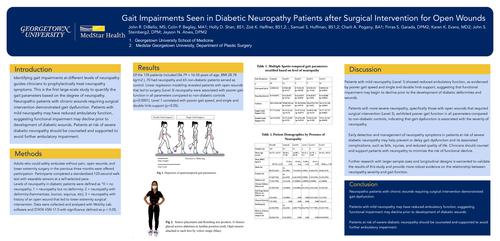
RESULTS:Of the 135 patients included (56.79 + 16.55 years of age, BMI 28.78 kg/m2 ), 70 had neuropathy and 65 non-diabetic patients served as control. Linear regression modeling revealed patients with open wounds that led to surgery (Level 3) neuropathy were associated with poorer gait function in all parameters compared to non-diabetic controls (p<0.0001). Level 1 correlated with poorer gait speed, and single and double limb support (p<0.05).
CONCLUSION: Patients at risk of severe diabetic neuropathy should be counseled and supported to avoid further ambulatory impairment.
Introduction
Identifying gait impairments at different levels of neuropathy guides clinicians to prophylactically treat neuropathy symptoms. This is the first large-scale study to quantify the gait parameters based on the degree of neuropathy. Neuropathic patients with chronic wounds requiring surgical intervention demonstrated gait dysfunction. Patients with mild neuropathy may have reduced ambulatory function, suggesting functional impairment may decline prior to development of diabetic wounds. Patients at risk of severe diabetic neuropathy should be counseled and supported to avoid further ambulatory impairment.
Methods
Adults who could safely ambulate without pain, open wounds, and lower extremity surgery in the previous three months were offered participation. Participants completed a standardized 120-second walk test with wearable sensors at a self-selected pace.
Levels of neuropathy in diabetic patients were defined as “0 = no neuropathy; 1 = neuropathy but no deformity; 2 = neuropathy with deformity (hammertoes, bunion, equinus, etc); 3 = neuropathy with history of an open wound that led to lower extremity surgical intervention. Data were collected and analyzed with Motility Lab software and STATA VSN 17.0 with significance defined as p < 0.05.
Results
Of the 135 patients included (56.79 + 16.55 years of age, BMI 28.78 kg/m2 ), 70 had neuropathy and 65 non-diabetic patients served as control. Linear regression modeling revealed patients with open wounds that led to surgery (Level 3) neuropathy were associated with poorer gait function in all parameters compared to non-diabetic controls (p<0.0001). Level 1 correlated with poorer gait speed, and single and double limb support (p<0.05).
Discussion
Patients with mild neuropathy (Level 1) showed reduced ambulatory function, as evidenced by poorer gait speed and single and double limb support, suggesting that functional impairment may begin to decline prior to the development of diabetic deformities and wounds.
Patients with more severe neuropathy, specifically those with open wounds that required surgical intervention (Level 3), exhibited poorer gait function in all parameters compared to non-diabetic controls, indicating that gait dysfunction is associated with the severity of neuropathy.
Early detection and management of neuropathy symptoms in patients at risk of severe diabetic neuropathy may help prevent or delay gait dysfunction and its associated complications, such as falls, injuries, and reduced quality of life. Clinicians should counsel and support patients with neuropathy to minimize the risk of functional decline.
Further research with larger sample sizes and longitudinal designs is warranted to validate the results of this study and provide more robust evidence on the relationship between neuropathy severity and gait function.