212 posters, 10 topics, 5 sessions, 754 authors, 237 institutions
ePostersLive by SciGen Technologies S.A. All rights reserved.
The AAPS 101st Annual Meeting
29 April – 2 May, 2023 | Chicago, IL

PC36
Peripheral And Trigeminal Nerve Stimulation Improve Functional Outcomes Of Nerve Recovery In A Rodent Forelimb Gap Repair Model
Poster Presenter
Part of Topic
Basic Science Research
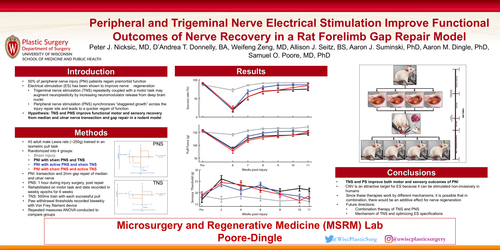
Peripheral and Trigeminal Nerve Electrical Stimulation Improve Functional Outcomes of Nerve Recovery in a Rat Forelimb Gap Repair Model
Introduction
•50% of peripheral nerve injury (PNI) patients regain premorbid function
•Electrical stimulation (ES) has been shown to improve nerve regeneration
•Trigeminal nerve stimulation (TNS) repeatedly coupled with a motor task may augment neuroplasticity by increasing neuromodulator release from deep brain nuclei
•Peripheral nerve stimulation (PNS) synchronizes “staggered growth” across the injury repair site and leads to a quicker regain of function
•Hypothesis: TNS and PNS improve functional motor and sensory recovery from median and ulnar nerve transection and gap repair in a rodent model
Methods
•45 adult male Lewis rats (~250g) trained in an isometric pull task
•Randomized into 4 groups:
•Sham injury
•PNI with sham PNS and TNS
•PNI with active PNS and sham TNS
•PNI with sham PNS and active TNS
•PNI: transection and 2mm gap repair of median and ulnar nerve
•PNS: 1 hour during injury surgery, post repair
•Rehabilitated on motor task and data recorded in weekly epochs for 6 weeks
•TNS: 500ms train with each successful pull
•Paw withdrawal thresholds recorded biweekly with Von Frey filament device
•Repeated measures ANOVA conducted to compare groups
Conclusions
•TNS and PS improve both motor and sensory outcomes of PNI
•CNV is an attractive target for ES because it can be stimulated non-invasively in humans
•Since these therapies work by different mechanisms, it is possible that in combination, there would be an additive effect for nerve regeneration
•Future directions:
•Combination therapy of TNS and PNS
•Mechanism of TNS and optimizing ES specifications