212 posters, 10 topics, 5 sessions, 754 authors, 237 institutions
ePostersLive by SciGen Technologies S.A. All rights reserved.
The AAPS 101st Annual Meeting
29 April – 2 May, 2023 | Chicago, IL

PC28
Retrospective Analysis Of Plastic Reconstructive Surgery Incidence Of Retained Surgical Items As Confirmed On X-rays
Poster Presenter
Part of Topic
Education/Practice Management/Other
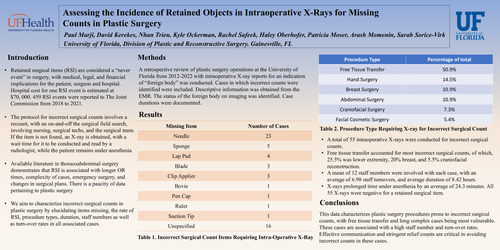
Introduction Retained surgical items (RSI) are considered a “never event” in surgery, with medical, legal, and financial implications for the patient, surgeon and hospital. Hospital cost for one RSI event is estimated at $70, 000. 459 RSI events were reported to The Joint Commission from 2018 to 2021. The protocol for incorrect surgical counts involves a recount, with an on-and-off the surgical field search, involving nursing, surgical techs, and the surgical team. If the item is not found, an X-ray is obtained, with a wait time for it to be conducted and read by a radiologist, while the patient remains under anesthesia. Available literature in thoracoabdominal surgery demonstrates that RSI is associated with longer OR times, complexity of cases, emergency surgery, and changes in surgical plans. There is a paucity of data pertaining to plastic surgery. We aim to characterize incorrect surgical counts in plastic surgery by elucidating items missing, the rate of RSI, procedure types, duration, staff numbers as well as turn-over rates in all associated cases.
Methods A retrospective review of plastic surgery operations at the University of Florida from 2012-2022 with intraoperative X-ray reports for an indication of “foreign body” was conducted. Cases in which incorrect counts were identified were included. Descriptive information was obtained from the EMR. The status of the foreign body on imaging was identified. Case durations were documented
Results A total of 55 intraoperative X-rays were conducted for incorrect surgical counts. Free tissue transfer accounted for most incorrect surgical counts, of which, 25.5% was lower extremity, 20% breast, and 5.5% craniofacial reconstruction. A mean of 12 staff members were involved with each case, with an average of 6.98 staff turnovers, and average duration of 8.42 hours. X-rays prolonged time under anesthesia by an average of 24.3 minutes. All 55 X-rays were negative for a retained surgical item.
Conclusions This data characterizes plastic surgery procedures prone to incorrect surgical counts, with free tissue transfer and long complex cases being most vulnerable. These cases are associated with a high staff number and turn-over rates. Effective communication and stringent relief counts are critical in avoiding incorrect counts in these cases.