212 posters, 10 topics, 5 sessions, 754 authors, 237 institutions
ePostersLive by SciGen Technologies S.A. All rights reserved.
The AAPS 101st Annual Meeting
29 April – 2 May, 2023 | Chicago, IL

D151
The Gender-Q: A Rigorous, Modular, Patient-reported Outcome Measure For Gender-affirming Care
Poster Presenter
Authors
Shane Morrison, Manraj Kaur, Shelby Deibert, Tim van de Grift, Astrid Hojgaard, Amalie Jacobsen, Natasha Johnson, Margriet Mullender, Lotte Poulsen, Thomas Satterwhite, Richard Santucci, John Semple, Charlene Rae, Kinusan Savard, Jens Sorensen, Danny Young-Afat, Andrea Pusic, Anne Klassen
Affiliations
Brigham and Women's Hospital, University of Washington Medical Center, McMaster University, Canada, VU Medical University, Netherlands, Aalborg University Hospital, Denmark, University of Southern Denmark and Odense University Hospital, Denmark, VU University Medical Center, Netherlands, University of Southern Denmark and Odense, Denmark, Align Surgical Associates Inc., Crane Center, Women’s College Hospital, Canada, Fleming College - Emeritus, Canada, Amsterdam University Medical Center, Netherlands, Brigham and Women’s Hospital
Part of Topic
Gender Affirmation
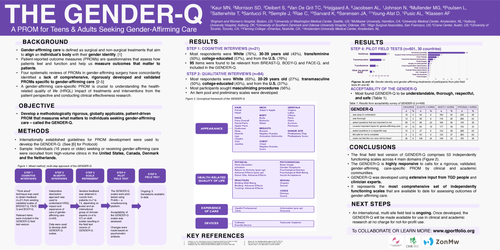
The Gender-Q: A PROM for Teens and Adults Seeking Gender Affirming Care
1Kaur MN, 2Morrison SD, 3Deibert S, 4Van De Grit TC, 5Højgaard A, 6Jacobsen AL, 1Johnson N, 4Mullender MG, 6Poulsen L, 7Satterwhite T, 8Santucci R, 9Semple J, 3Rae C, 10Sarvard K, 6Sørensen JA, 11Young-Afat D, 1Pusic AL, 3Klassen AF
1Brigham and Women’s Hospital, Boston, US; 2University of Washington Medical Center, Seattle, US; 3McMaster University, Hamilton, CA; 4University Medical Center, Amsterdam, NL; 5Aalborg University Hospital, Aalborg, DK; 6University of Southern Denmark and Odense University Hospital, Odense, DK; 7Align Surgical Associates, San Francisco, US; 8Crane Center, Austin, US; 9University of Toronto, Toronto, CA; 10Fleming College –Emeritus, Noelville, CA; 11Amsterdam University Medical Center, Amsterdam, NL
Background
STEP 1: COGNITIVE INTERVIEWS (n=21)
STEP 2: QUALITATIVE INTERVIEWS (n=84)
STEP 4: PILOT FIELD TESTS (n=601, 30 countries)
ACCEPTABILITY OF THE GENDER-Q
Next Steps
4. Barone, M., et al. Aesthetic plastic surgery 41 (2017): 700-713.
5. Oles, Norah, et al. Annals of surgery 275.1 (2022): e52-e74.
6. Klassen, Anne F., et al. BMJ open 8.10 (2018): e025435.