212 posters, 10 topics, 5 sessions, 754 authors, 237 institutions
ePostersLive by SciGen Technologies S.A. All rights reserved.
The AAPS 101st Annual Meeting
29 April – 2 May, 2023 | Chicago, IL

D98
Access To Certified Burn Centers In The United States: The Geospatial And Transport Cost Of Transfer
Poster Presenter
Authors
Shelley Edwards, Gabrielle Chamoun, Madyson Brown, Emily Hecox, Ian Hoppe, Peter Arnold, Laura Humphries
Affiliations
University of Mississippi Medical Center, Program In Neuroscience, University of Mississippi Medical Center, School of Medicine, University of Mississippi Medical Center, Division of Plastic and Reconstructive Surgery
Part of Topic
Education/Practice Management/Other
ACCESS TO CERTIFIED BURN CENTERS IN THE UNITED STATES: THE GEOSPATIAL AND TRANSPORT COST OF TRANSFER
Shelley R. Edwards, BS1, Gabrielle Chamoun, BS2, Madyson I. Brown, BS2, Emily Hecox MD3, Ian C. Hoppe, MD3, Peter Arnold, MD PhD3, Laura S. Humphries, MD3.
1 University of Mississippi Medical Center, Program In Neuroscience, Jackson, MS, USA; 2 University of Mississippi Medical Center School of Medicine, Jackson, MS, USA; 3 University of Mississippi Medical Center, Division of Plastic and Reconstructive Surgery, Jackson, MS, USA
INTRODRUCTION
• Approximately 300,000 burn injuries required medical intervention in the US in 2020, including 70,000 in pediatric patients.1
• Although ABA-verified burn centers are pivotal in reducing burn associated morbidity and mortality, 25-50% of patients meeting transfer criteria are treated entirely at non-burn center hospitals.2, 3
• ABA-verified burn centers are limited in number and unequally distributed throughout the country – thereby contributing to access disparities for pediatric and rural patients.
• Patients with already limited access likely face greater financial hardship than their peers due to longer transport distances and the need for more costly modes of transport (i.e., Air Ambulance).4
• Present literature is insufficient to directly compare burn care access between different patient populations based on physical proximity and the estimated cost of transportation to the nearest verified burn center.
METHODS
• Verified centers (n = 59 adult and 43 pediatric) were identified via ABA burn center directory (accessed: September 28, 2022)
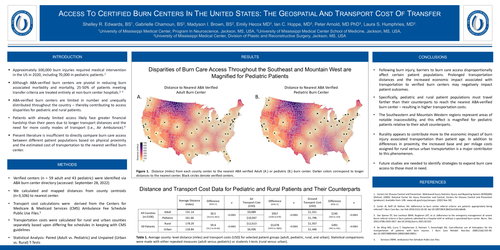
• We calculated and mapped distances from county centroids (n=3,106) to nearest center.
• Transport cost calculations were derived from the Centers for Medicare & Medicaid Services (CMS) Ambulance Fee Schedule Public Use Files.5
• Transportation costs were calculated for rural and urban counties separately based upon differing fee schedules in keeping with CMS guidelines
• Statistical Analysis: Paired (Adult vs. Pediatric) and Unpaired (Urban Vs. Rural) T-Tests
CONCLUSIONS
• Following burn injury, barriers to burn care access disproportionally affect certain patient populations. Prolonged transportationdistances and the increased economic impact associated with transportation to verified burn centers may negatively impact patient outcomes.
• Specifically, pediatric and rural patient populations must travel farther than their counterparts to reach the nearest ABA-verified burn center – resulting in higher transportation costs.
• The Southeastern and Mountain Western regions represent areas of notable inaccessibility, and this effect is magnified for pediatric patients relative to their adult counterparts.
• Rurality appears to contribute more to the economic impact of burn injury associated transportation than patient age. In addition to differences in proximity, the increased base and per milage costs assigned for rural versus urban transportation is a major contributor to this phenomenon.
• Future studies are needed to identify strategies to expand burn care access to those most in need.