212 posters, 10 topics, 5 sessions, 754 authors, 237 institutions
ePostersLive by SciGen Technologies S.A. All rights reserved.
The AAPS 101st Annual Meeting
29 April – 2 May, 2023 | Chicago, IL

D71
Meta-analyses In Plastic Surgery Demonstrate Need For Adequate Assessment Of Publication Bias
Poster Presenter
Part of Topic
Education/Practice Management/Other
Meta-analyses in Plastic Surgery Demonstrate Need for Adequate Assessment of Publication Bias
Introduction:Publication bias describes a phenomenon in which significant positive results have higher likelihood to be published compared to negative or non-significant results. Publication bias can confound the estimated therapeutic effect in meta-analyses and needs to be adequately assessed in Plastic Surgery literature. Meta-analyses are subject to publication bias due to the aggregation of results from multiple studies. There exist both subjective and objective methods that investigators can use to determine if a meta-analysis is influenced by publication bias, checking that cumulative data does not over-estimate positive results.
Evidence-Based Medicine, Meta-analyses & Assessment of Publication Bias
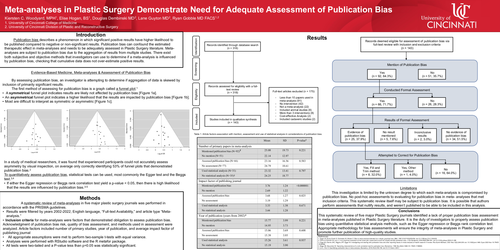
By assessing publication bias, an investigator is attempting to determine if aggregation of data is skewed by inclusion of primarily significant results.The first method of assessing for publication bias is a graph called a funnel plot. A symmetrical funnel plot indicates results are likely not affected by publication bias [Figure 1a]. An asymmetrical funnel plot indicates a higher likelihood that the results are impacted by publication bias [Figure 1b]. Most are difficult to interpret as symmetric or asymmetric [Figure 1c].In a study of medical researchers, it was found that experienced participants could not accurately assess asymmetry by visual inspection, on average only correctly identifying 53% of funnel plots that demonstrated publication bias.2
To quantitatively assess publication bias, statistical tests can be used, most commonly the Egger test and the Beggs test.If either the Egger regression or Beggs rank correlation test yield a p-value < 0.05, then there is high likelihood that the results are influenced by publication bias.
Methods: A systematic review of meta-analyses in five major plastic surgery journals was performed in accordance with the PRISMA guidelines. Results were filtered by years 2002-2022, English language, “Full-text Availability,” and article type “Meta-analysis.” Inclusion criteria for meta-analyses were factors that demonstrated obligation to assess publication bias.Acknowledgment of publication bias risk, quality of bias assessment, and methods used in assessment were analyzed. Article factors included number of primary studies, year of publication, and average impact factor of publishing journal. All appropriate assumptions were met to perform two-sample t-tests with equal variance. Analyses were performed with RStudio software and the R metafor package. All tests were two-tailed and a P-value less than p=0.05 was statistically significant.
Limitations: This investigation is limited by the unknown degree to which each meta-analysis is compromised by publication bias. No post-hoc assessments to evaluating for publication bias in meta- analyses that met inclusion criteria. This systematic review itself may be subject to publication bias. It is possible that authors perform assessments that nullify results, andweren’t published to be able to be included in this analysis.
Conclusions: This systematic review of five major Plastic Surgery journals identified a lack of proper publication bias assessment in meta-analyses published in Plastic Surgery literature. It is the duty of investigators to properly assess publication bias using quantitative statistical analysis methods, such as the Egger regression or Beggs rank correlation test. Appropriate methodology for bias assessments will ensure the integrity of meta-analyses in Plastic Surgery and promote further publication of high-quality studies.