212 posters, 10 topics, 5 sessions, 754 authors, 237 institutions
ePostersLive by SciGen Technologies S.A. All rights reserved.
The AAPS 101st Annual Meeting
29 April – 2 May, 2023 | Chicago, IL

D63
“Flying Squirrel” Liposuction In Treating Post-mastectomy Arm Lymphedema - 2-year Experience
Poster Presenter
Authors
Mazen Al-Malak, Jacob Lammers, Brian Figueroa, Sonia Pandey, Ying Ku, Lianne Mulvihill, Wei F.Chen
Affiliations
Part of Topic
Hand/Extremity
“Flying Squirrel” Liposuction In Treating Post-mastectomy Arm Lymphedema - 2-year Experience:
Author Block: Mazen Al-Malak, MD, Jacob Lammers, DO, Brian Figueroa, MD, Sonia Pandey, MD, Ying Ku, BS, Lianne Mulvihill, BA, Wei F. Chen, MD.
Cleveland Clinic, Cleveland, OH, USA.
Abstract:
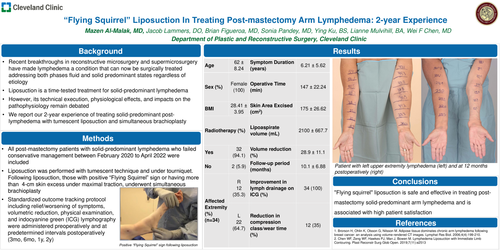
PURPOSE: Liposuction is a time-tested treatment for solid-predominant lymphedema. However, its technical execution, physiological effects, and impacts on the pathophysiology remain debated. In this study we report our 2-year experience of treating solid-predominant post-mastectomy arm lymphedema with tumescent liposuction with simultaneous brachioplasty.
METHODS: All post-mastectomy patients with solid-predominant lymphedema who failed conservative management between February 2020 to April 2022 were included. Liposuction was performed with tumescent technique and under tourniquet. Following liposuction, those with positive “flying squirrel” sign, or having more than 4-cm skin excess under maximal traction, underwent simultaneous brachioplasty. Standardized outcome tracking protocol including relief/worsening of symptoms, volumetric reduction, physical examination, and indocyanine green (ICG) lymphography were administered preoperatively and at predetermined intervals postoperatively.
RESULTS: 34 female patients were included. All demonstrated positive “flying squirrel” sign and underwent immediate brachioplasty. Average operative time was 147 minutes. No intraoperative or postoperative complications were encountered. Average lipoaspirate volume and percentage of adipose tissues were 2,100 cc and 71%. Average skin excised was 175 sq cm. The follow-up period averaged 10.1 months (range 3-24 months). At the latest follow-up, 22 patients had complete arm volume data, showing 28.9±11.1% volume reduction. All reported notable relief of symptoms and function improvement. On ICG lymphography, all patients also demonstrated progressive improvement in lymph drainage. 35% (12/34) of patients managed to reduce compression class and/or wear time. All expressed satisfaction with the procedure.
CONCLUSION: "Flying squirrel" liposuction is safe and effective in treating post-mastectomy solid-predominant arm lymphedema and is associated with high patient satisfaction.