212 posters, 10 topics, 5 sessions, 754 authors, 237 institutions
ePostersLive by SciGen Technologies S.A. All rights reserved.
The AAPS 101st Annual Meeting
29 April – 2 May, 2023 | Chicago, IL

D61
Management Of Recurrent Morton’s Neuromas With Targeted Muscle Reinnervation
Part of Topic
Hand/Extremity
Management of Recurrent Morton’s Neuromas with Targeted Muscle Reinnervation
Authors:
Iulianna Taritsa1, Dr. Simon Moradian2, Dr. Gregory Dumanian2, Dr. Jason Ko2
1Feinberg School of Medicine at Northwestern Memorial Hospital, 2Department of Plastic and Reconstructive Surgery, Northwestern Memorial Hospital
Background:
Morton’s interdigital neuroma is a common cause severe foot pain which can severely impact a patient’s quality of life. The causes of nerve pain can be due to entrapment of the common plantar digital nerve by the deep transverse inter-metatarsal ligament, trauma to the plantar digital nerves, ischemia, or bursitis. Operative interventions for this condition include neurolysis, decompression, or neurectomy which often may result in persistent post-operative pain and true neuroma formation, with failure rates reported between 15 to 49%. Targeted muscle reinnervation (TMR) is a surgical technique developed by the senior author that has demonstrated efficacy in the treatment of neuroma pain. However, this has not been described as an option for the treatment and prevention of the recurrence of Morton’s neuroma.
Research Objective:
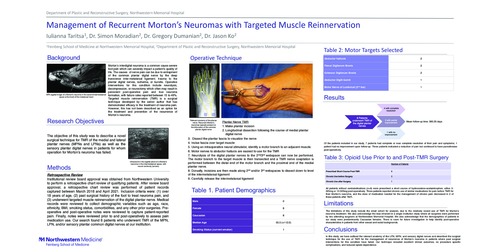
The objective of this study was to describe a novel surgical technique for TMR of the medial and lateral plantar nerves (MPNs and LPNs) as well as the sensory plantar digital nerves in patients for whom operation for Morton’s neuroma has failed.
Methods:
Retrospective Review
Institutional review board approval was obtained from Northwestern University to perform a retrospective chart review of qualifying patients. After review board approval, a retrospective chart review was performed of patient records captured between March 2018 and April 2021. Inclusion criteria were: (1) over 18 years of age, (2) past surgical history of the foot to treat neuroma pain, and (3) underwent targeted muscle reinnervation of the digital plantar nerve. Medical records were reviewed to collect demographic variables such as age, race, ethnicity, BMI, smoking status, comorbidities, and any other prior surgeries. Pre-operative and post-operative notes were reviewed to capture patient-reported pain. Finally, notes were reviewed prior to and post-operatively to assess pain medication use. Our search found 8 patients who underwent TMR of the MPN, LPN, and/or sensory plantar common digital nerves at our institution.
Operative Technique:
Plantar Nerve TMR
Of the patients included in our study, 7 patients had complete or near complete resolution of their pain and symptoms; 1 patient had no improvement upon follow-up. Three patients indicated a reduction of pain but continued to have paresthesias post-operatively.
All patients without contraindications (n=6) were prescribed a short course of hydrocodone-acetaminophen, either 5-325mg or 10-325mg post-operatively. Three patients reported chronic use of similar medications for pain before TMR for their Morton’s neuroma, and the dose of medication needed for the management of chronic pain decreased in 2 of these patients after TMR.
Limitations:
The limitations of this study include the small cohort for analysis, due to the relatively recent use of TMR for Morton’s neuroma treatment. We also acknowledge the bias inherent in a single institution study where all surgeries were performed by two attending surgeons at Northwestern Memorial Hospital. We also acknowledge that the demographics of patients in our study were predominantly Caucasian females. There is room for future investigation to help identify post-operative characteristics in patients from other sexual and racial backgrounds.
Conclusions:
In this study, we have outlined the relevant anatomy of the LPN, MPN, and sensory digital nerves and described the surgical technique for the use of TMR for the management of recurrence of Morton’s neuroma in patients where past surgical interventions for this condition have failed. Our technique revealed excellent clinical outcomes, no procedure specific complications, and reduced opiate dependence.