171 posters, 10 topics, 5 sessions, 690 authors, 211 institutions
ePostersLive by SciGen Technologies S.A. All rights reserved.
American Association of Plastic Surgeons Meeting 2022
April 9 - 12 | San Diego, California

PC26
Pediatric Dog Bite Injuries: A 5-year Nationwide Study Of Over 56,000 Patients
Poster Presenter
Authors
Affiliations
Part of Topic
Craniofacial/Peds
Introduction
Dog bites represent a disproportionately high percentage of ED visits in children, yet a multi-center investigation into this phenomenon is lacking. The purpose of this study is to develop a nationwide dataset of pediatric dog bites and assess specific injury patterns.
Methods
Retrospective cohort study was conducted of dog bite injuries admitted to tertiary pediatric hospitals in the United States from 2010 through 2020 using the Pediatric Health Information System. Patient characteristics, injury locations, and need for intervention were analyzed with appropriate statistics.
Results
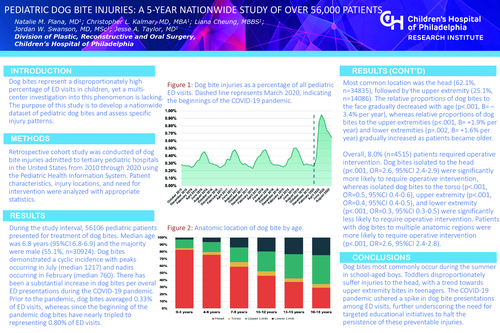
During the study interval, 56106 pediatric patients presented for treatment of dog bites. Median age was 6.8 years (95%CI 6.8-6.9) and the majority were male (55.1%, n=30924). Dog bites demonstrated a cyclic incidence with peaks occurring in July (median 1217) and nadirs occurring in February (median 760). There has been a substantial increase in dog bites per overall ED presentations during the COVID-19 pandemic. Prior to the pandemic, dog bites averaged 0.33% of ED visits, whereas since the beginning of the pandemic dog bites have nearly tripled to representing 0.80% of ED visits.
Most common location was the head (62.1%, n=34835), followed by the upper extremity (25.1%, n=14086). The relative proportions of dog bites to the face gradually decreased with age (p<.001, B= –3.4% per year), whereas relative proportions of dog bites to the upper extremities (p<.001, B= +1.9% per year) and lower extremities (p=.002, B= +1.6% per year) gradually increased as patients became older.
Overall, 8.0% (n=4515) patients required operative intervention. Dog bites isolated to the head (p<.001, OR=2.6, 95%CI 2.4-2.9) were significantly more likely to require operative intervention, whereas isolated dog bites to the torso (p<.001, OR=0.5, 95%CI 0.4-0.6), upper extremity (p<.001, OR=0.4, 95%CI 0.4-0.5), and lower extremity (p<.001, OR=0.3, 95%CI 0.3-0.5) were significantly less likely to require operative intervention. Patients with dog bites to multiple anatomic regions were more likely to require operative intervention (p<.001, OR=2.6, 95%CI 2.4-2.8).
Conclusions
Dog bites most commonly occur during the summer in school-aged boys. Toddlers disproportionately suffer injuries to the head, with a trend towards upper extremity bites in teenagers. The COVID-19 pandemic ushered a spike in dog bite presentations among ED visits, further underscoring the need for targeted educational initiatives to halt the persistence of these preventable injuries.