171 posters, 10 topics, 5 sessions, 690 authors, 211 institutions
ePostersLive by SciGen Technologies S.A. All rights reserved.
American Association of Plastic Surgeons Meeting 2022
April 9 - 12 | San Diego, California

P142
Prediction Of Adverse Outcomes Following Free Tissue Transfer Using Lace Index For The Treatment Of Chronic Lower Extremity Wounds
Poster Presenter
Part of Topic
Hand/Extremity
Prediction Of Adverse Outcomes Following Free Tissue Transfer Using LACE Index For The Treatment Of Chronic Lower Extremity Wounds
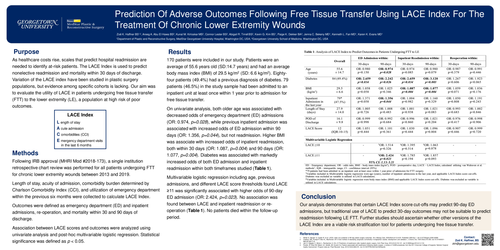
PURPOSE: As healthcare costs rise, scales that predict hospital readmission are needed to identify at-risk patients. The LACE Index is used to predict nonelective readmission and mortality within 30 days of discharge. Variation of the LACE index have been studied in plastic surgery populations, but evidence among specific cohorts is lacking. Our aim was to evaluate the utility of LACE in patients undergoing free tissue transfer (FTT) to the lower extremity (LE), a population at high risk of poor outcomes.
METHODS: Following IRB approval (MHRI Mod #2018-173), a single institution retrospective chart review was performed for all patients undergoing FTT for chronic lower extremity wounds between 2013 and 2019. Length of stay, acuity of admission, comorbidity burden determined by Charlson Comorbidity Index (CCI), and utilization of emergency department within the previous six months were collected to calculate LACE Index. Outcomes were defined as emergency department (ED) and inpatient admissions, re-operation, and mortality within 30 and 90 days of discharge. Association between LACE scores and outcomes were analyzed using univariate analysis and post-hoc multivariable logistic regression. Statistical significance was defined as p < 0.05.
RESULTS: 170 patients were included in our study. Patients were an average of 55.6 years old (SD:14.7 years) and had an average body mass index (BMI) of 29.5 kg/m2 (SD: 6.6 kg/m2). Eighty- four patients (49.4%) had a previous diagnosis of diabetes. 79 patients (46.5%) in the study sample had been admitted to an inpatient unit at least once within 1 year prior to admission for free tissue transfer.
On univariate analysis, both older age was associated with decreased odds of emergency department (ED) admissions (OR: 0.974, p=0.028), while previous inpatient admission was associated with increased odds of ED admission within 90 days (OR: 1.356, p=0.044), but not readmission. Higher BMI was associate with increased odds of inpatient readmission, both within 30 days (OR: 1.087, p=0.004) and 90 days (OR: 1.077, p=0.004). Diabetes was associated with markedly increased odds of both ED admission and inpatient readmission within both timeframes studied (Table 1).
Multivariable logistic regression including age, previous admissions, and different LACE score thresholds found LACE ≥11 was significantly associated with higher odds of 90-day ED admission (OR: 2.424, p=0.023). No association was found between LACE and inpatient readmission or re- operation (Table 1). No patients died within the follow-up period.
CONCLUSION: Our analysis demonstrates that certain LACE Index score cut-offs may predict 90-day ED admissions, but traditional use of LACE to predict 30-day outcomes may not be suitable to predict readmission following LE FTT. Further studies should ascertain whether other versions of the LACE Index are a viable risk stratification tool for patients undergoing free tissue transfer.
REFERENCES:
1. Winter E, Glauser G, Caplan IF, et al. LACE+ index as a predictor of 90-day plastic surgery outcomes. Am J Manag Care. 2020;26(4):e113-e120. Published 2020 Apr 1. doi:10.37765/ajmc.2020.42838
2. Charlson ME, Pompei P, Ales KL, MacKenzie CR. A new method of classifying prognostic comorbidity in longitudinal studies: development and validation. J Chronic Dis. 1987;40(5):373-383. doi:10.1016/0021-
9681(87)90171-8
3. Jain U, Salgado C, Mioton L, Rambachan A, Kim JY. Predictors of readmission after inpatient plastic surgery. Arch Plast Surg. 2014;41(2):116-121. doi:10.5999/aps.2014.41.2.116
4. Fischer JP, Wes AM, Nelson JA, Serletti JM, Kovach SJ. Factors associated with readmission following plastic surgery: a review of 10,669 procedures from the 2011 American College of Surgeons National Surgical Quality Improvement Program data set. Plast Reconstr Surg. 2013;132(3):666-674. doi:10.1097/PRS.0b013e31829acc8c